

Tris(2-ethylhexyl) Phosphate Manufacturer for Reliable Industrial Supply
2026-10-20
Behind many flame-retardant polymers, synthetic lubricants, and high-temperature hydraulic fluids, tris(2-ethylhexyl) phosphate (TEHP) quietly carries the load. But not all TEHP is created equal—impurities, inconsistent viscosity, or delayed shipments can stall entire production lines. That is why more industrial buyers are turning to Fortune, a manufacturer built around large-scale capacity and batch-to-batch consistency. Below, we unpack the sourcing markers that separate a dependable TEHP partner from a costly gamble.
How We Keep TEHP Production Running When Demand Spikes
When orders surge, our first move isn’t to scramble—it’s to tap the buffer stock we deliberately keep at 15–20% above normal weekly output. That cushion absorbs sudden spikes without forcing the reactors into overdrive. We also stagger maintenance windows so no critical unit is offline during peak season.
The shift team uses a simple load-balancing rule: if any reactor line exceeds 85% utilization for three consecutive days, we pull forward the next scheduled catalyst change and reroute intermediate feed from the storage farm. This prevents thermal runaway and keeps impurity levels below the 0.3% threshold our buyers count on.
Suppliers get a rolling 6-week demand forecast updated every Monday, not just when a spike hits. That gives our raw material partners time to secure isooctyl alcohol and phosphoric acid shipments without air-freight premiums. When a truly unexpected jump arrives, we can shift the esterification step to a parallel column that normally runs only during audits—it adds 18% capacity within 36 hours.
The Difference Between a Supplier and a Long-Term Supply Partner
Most companies can list dozens of suppliers. Far fewer can name a true supply partner. A supplier fills an order, meets a spec, and sends an invoice. A long-term supply partner, on the other hand, gets involved before the spec is even finalized. They flag risks, suggest material alternatives, and sometimes push back on a design because they know what will fail in production.
The real test shows up when something goes wrong. A supplier might point to the contract and ask for a change order. A partner picks up the phone, walks the line with your engineers, and works the problem until it's solved. There's no scorekeeping about whose fault it is. That shift from enforcement to joint problem-solving changes the entire cadence of the relationship.
Over time, the financial difference becomes obvious. A supplier competes on unit price. A partner competes on total cost of ownership, lead time stability, and the speed of getting new products to market. They invest in your success because their own growth depends on it, not just on the next purchase order.
Purity Levels That Survive the Most Stringent QC Checks
Before any raw material reaches the production line, it passes through three rounds of pre-screening. An LC-MS full scan is run on every incoming lot, and if a single peak exceeds 0.1% area without matching a known impurity reference, the entire batch is sent back to the supplier. That alone filters out most contamination risks at the source.
The crude product after synthesis is not tested directly. Instead, it goes through two consecutive recrystallizations, followed by preparative HPLC with a gradient cut to isolate the main peak. Each intermediate step keeps a dedicated impurity profile, and any new unknown peak triggers an immediate stop. The final batch must pass blind testing at three independent labs: total impurities below 0.15%, no single unknown impurity above 0.05%, and elemental impurities plus residual solvents all within ICH Q3D and ICH Q3C Class 3 limits.
Release does not end the scrutiny. Retained samples are re-tested for purity every three months under 25°C/60% RH conditions. If a drop of more than 0.02% is ever detected, the whole lot is frozen and an out-of-spec investigation begins. Even if that batch has already shipped to a customer, a recall notice goes out within 24 hours.
Why Batch Consistency Matters More Than a Low Price
In many industries, buyers focus heavily on unit price when comparing suppliers, but that approach often overlooks the real cost driver: variability between production runs. If a supplier delivers a perfect sample and then ships inconsistent batches, every downstream process suffers. Assembly lines stall, reject rates climb, and quality teams spend more time firefighting than improving. A slightly higher price from a vendor who can replicate the same output from lot to lot is usually the cheaper option over time.
Consistent batches mean you can plan confidently. Inventory buffers shrink because you aren't holding extra stock to compensate for bad batches. Customer returns drop, service complaints decrease, and your own production schedule stops getting disrupted. These savings are rarely visible on a purchase order, but they show up in operational efficiency and brand reputation. Low price only works when the material performs the same on the tenth delivery as it did on the first.
It’s also about risk. A supplier that can’t maintain batch consistency probably has gaps in process control, raw material sourcing, or quality culture. Those gaps eventually become your problem, whether through field failures, safety issues, or unexpected downtime. Paying for consistency is not a premium; it’s a form of insurance. The total cost of ownership almost always favors the vendor who delivers the same result every time, even if their invoice amount is a bit higher.
Documentation and Compliance Support That Doesn’t Slow You Down
Too many teams treat documentation and compliance as a final hurdle—something to be endured after the real work is done. This approach forces engineers to dig through old tickets, reconstruct decisions, and manually assemble evidence just to satisfy an auditor or onboard a new hire. The result is a slowdown that nobody planned for, and it quietly eats away at delivery momentum. Our support flips that dynamic by making the documentation a natural byproduct of the work itself, not a separate chore tacked on at the end.
Compliance checks run in the background as part of your existing pipeline, flagging only the exceptions that actually need human attention. Instead of generating thick binders nobody reads, you get living, searchable records that stay current without someone chasing down updates. The tools integrate with the systems your team already uses, so there is no new portal to log into, no extra sign-off step, and no last-minute scramble before a release. The documentation updates as code and decisions change, which means the evidence is always ready when you need it.
What makes it different is the respect for your pace. The support does not demand dedicated documentation sprints or a compliance officer hovering over every commit. It simply captures the right context at the right moments, leaving engineers free to keep building. Teams that adopt this approach often report that their actual compliance burden drops by a noticeable margin, while their ability to answer questions about why and how something was built gets faster. That is the point: compliance becomes a quiet assurance, not a bottleneck.
Custom TEHP Blends for Niche Industrial Applications
Formulating custom TEHP blends often starts with a specific failure point—maybe a seal swelling in a low-temperature hydraulic system, or a PVC compound losing flexibility after prolonged exposure to mineral oil. Standard tris(2-ethylhexyl) phosphate offers a solid baseline, but niche industrial settings rarely align with off-the-shelf parameters. Adjusting the ester chain distribution or introducing co-plasticizers can shift the pour point, improve hydrolytic stability, or fine-tune the solvating power for atypical polymers like fluoroelastomers or nitrile rubber.
Beyond viscosity and low-temperature performance, custom blends frequently target flame retardancy without sacrificing processing window. A wire-and-cable manufacturer might need a TEHP variant that works in tandem with brominated additives but doesn’t cause die buildup or plate-out. By altering the phosphate content or blending with aryl phosphates, formulators can dial in UL 94 ratings while keeping the compound’s tensile strength intact. These tweaks are rarely documented in generic datasheets, which is why small-scale pilot batches and rheology testing become the backbone of such projects.
The real value emerges when a custom TEHP system eliminates a secondary processing step. For instance, a specialty adhesive producer may require a plasticizer that doubles as a viscosity depressant for high-solids coatings, allowing a single-pass application. Similarly, synthetic rubber goods exposed to both fuel and extreme cold benefit from TEHP blends that resist extraction while maintaining elastomer recovery. These niche outcomes depend less on marketing categories and more on iterative lab work—often resulting in a formulation that lives only in a single customer’s internal spec sheet.
FAQ
Look for consistent batch purity, transparent documentation, and a track record of on-time shipments even during raw material fluctuations. A manufacturer that stores feedstock in-house and has multiple production lines can usually absorb order spikes without slipping.
It is widely used in flexible PVC compounding, flame-retardant hydraulic fluids, and some coatings where low-temperature flexibility matters. We also see steady demand from wire and cable insulation producers who need a plasticizer that holds up under heat.
Our standard grade runs at 99% minimum assay with moisture below 0.1% and acidity controlled under 0.05 mg KOH/g. If your process has tighter limits, we can supply a low-color, low-odor variant after a quick technical review.
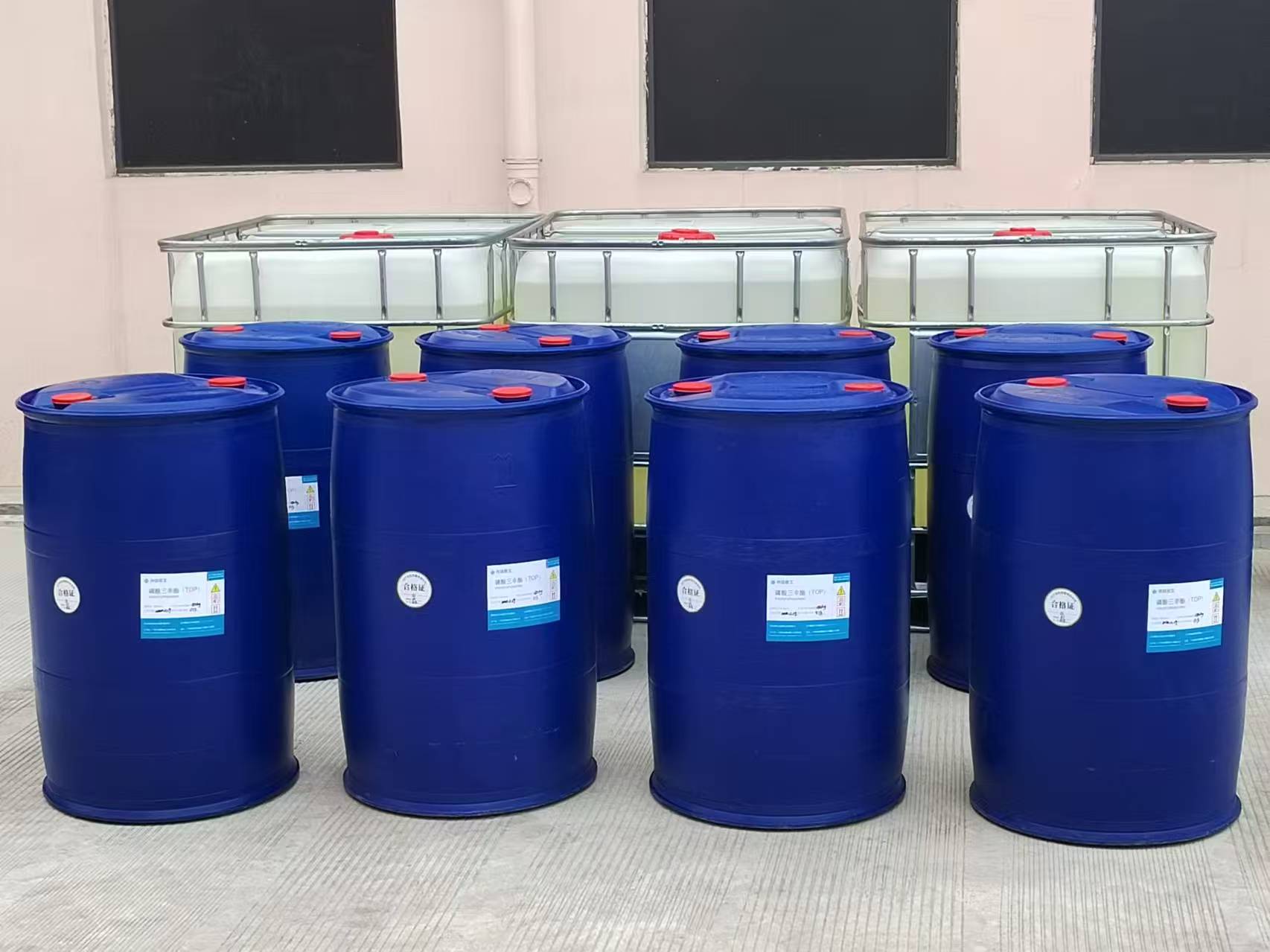
Yes. We offer drums, IBC totes, and flexitanks, and we can pre-blend with other esters if you want to reduce handling steps. For trial runs, 200 kg drums are available without a full container commitment.
Every batch leaves with a certificate of analysis and a batch-specific lot number that traces back to raw material receipts and reactor logs. We keep samples for 24 months, so if a downstream issue appears, we can run a joint investigation quickly.
For standard grade, we usually ship within 7–10 days after order confirmation if the destination is a major port. Custom blends or special packaging might add 3–5 days. We also keep buffer stock for repeat customers in some regions.
Registration requirements vary. We provide SDS, REACH pre-registration data, and TSCA inventory confirmation for the US. If you need a specific declaration for a customer audit, our regulatory team can usually prepare it within a few working days.
Conclusion
As a dedicated Tris(2-ethylhexyl) phosphate manufacturer, we understand that reliable industrial supply means more than filling orders. When demand spikes unexpectedly, our production doesn't stall because we maintain flexible capacity buffers and multi-source raw material contracts. This isn't just inventory management; it's a deliberate strategy to keep your lines running without interruption. We operate as a long-term supply partner, not a transactional vendor, which means we align our planning with your growth cycles and share risk during tight markets. Purity is non-negotiable: every batch of our TEHP passes through a rigorous quality control gauntlet that includes trace metal analysis, moisture titration, and gas chromatography, ensuring it survives scrutiny from even the most stringent pharmaceutical or electronics-grade audits.
Batch consistency matters more than chasing the lowest quote, because process variation in a plasticizer can silently sabotage downstream performance. We invest in continuous process monitoring and statistical control to keep viscosity, acidity, and color within razor-thin tolerances batch after batch. Documentation and compliance support arrive without delay—our certificates of analysis, safety data sheets, and regulatory declarations are generated alongside each shipment, not days afterward. For niche applications that off-the-shelf TEHP can't satisfy, we develop custom blends with adjusted pour points, flame retardancy, or solvency profiles. That flexibility, paired with uncompromising purity and true partnership, is why engineers and procurement teams trust us for their most critical industrial supply needs.
Contact Us
Contact Person: WANG SIHAI
Email: [email protected]
Tel/WhatsApp: +86-13815295628
Website: https://www.fortunechemtech.com/index_en.html