

Reduction Mill for Flat and Rectangular Wire: Advanced Rolling Technology for Precision Profiles
2026-07-30
As demand grows for perfectly flat and rectangular wire with micron-level precision, age-old rolling techniques can't keep pace. GRM's reduction mill steps in—a fusion of intelligent design and relentless power that turns raw stock into pinpoint profiles at speed. Curious how it achieves what others only promise? Read on as we unpack the tech behind the mill and its quiet revolution in profile rolling.
How Precision Rolling Transforms Wire Profiles
Precision rolling reshapes wire profiles by carefully controlling pressure and movement against forming rolls. The process reduces the wire's cross-section in a single pass or multiple passes, perfectly reworking the metal's grain structure without cutting. This cold working technique not only modifies the outer shape into complex geometries—such as square, rectangular, or custom contours—but also aligns the grain flow continuously along the profile, which leads to a stronger, more uniform material. Every micrometre of deformation is guided with high accuracy, so that the final profile meets exact dimensional tolerances without excess material loss.
Unlike traditional drawing or machining, precision rolling delivers a surface finish that often requires no subsequent polishing. As the wire passes through carefully calibrated rollers, surface imperfections are smoothed out and work hardening occurs, increasing tensile strength while maintaining the ductility needed for further forming. The method easily handles materials that are tough or brittle, because the gradual compression avoids stress concentrations. It's a reliable way to achieve wire shapes that conventional processes struggle with—think intricate groove designs or asymmetric sections—all while keeping the substrate's integrity intact.
Another key transformation lies in how rolling optimizes material usage. There's minimal scrap since the metal is displaced instead of removed, keeping costs down for high-volume production. The constant force applied across the profile ensures consistent mechanical properties from start to finish of a coil. Combined with the ability to hold cross-sectional accuracy within microns, precision rolling gives engineers the freedom to design wire profiles that precisely match performance needs in demanding applications like medical devices, aerospace components, and precision springs, where every contour counts.
The Mechanics Behind Flat and Rectangular Wire Reduction
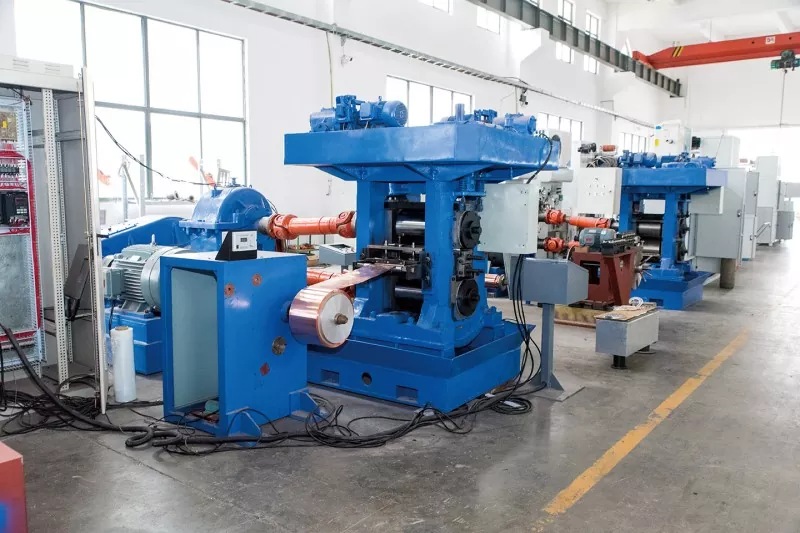
Wire reduction from round to flat or rectangular profiles isn't just a simple squashing operation—it's a carefully controlled sequence of plastic deformation steps. The process typically begins with a round wire feedstock, which is drawn or rolled through progressively shaped dies or rolls. Each pass applies enough pressure to exceed the material's yield strength, causing permanent shape change without fracturing. The key challenge is managing lateral spread: as the wire is compressed in one direction, it naturally tries to expand in the perpendicular direction. Controlling this spread is critical to achieving precise width and thickness dimensions. Tooling geometry, reduction per pass, and lubrication all play decisive roles in how the metal flows, because too aggressive a reduction can induce edge cracking or internal stresses that compromise the final product.
At the microstructural level, flat and rectangular wire reduction forces metal grains to elongate and reorient along the direction of working. This grain refinement isn't uniform—the surface layers experience more shear and hardening than the core, creating a gradient in mechanical properties. In multi-pass schedules, intermediate annealing steps may be inserted to restore ductility, allowing further shape refinement without tearing. The mechanics also depend heavily on the aspect ratio being targeted: narrow, thick profiles behave differently than wide, thin ones. For wider sections, roll flattening or Turk's head rolling setups are often used to constrain lateral flow, while narrower ribbons might rely more on wire flattening mills with precise gap control. Every adjustment in roll pressure or die angle directly influences the material's springback and residual stress distribution, which become critical when the final component must maintain tight tolerances under springback.
Material choice further complicates the mechanics. Ductile alloys like copper or aluminum can tolerate larger reductions per pass, whereas high-strength steels may require smaller incremental deformation and more frequent stress relief. Surface finish and edge quality are also byproducts of the reduction mechanics—improper lubrication or worn tooling can introduce micro-tears that propagate later during coiling or bending. At its core, the process is a balancing act between force, friction, and material work hardening. Real-world expertise comes from interpreting how these factors interact, and experienced toolmakers often rely on empirical adjustments as much as on finite-element models. The result is a flat or rectangular wire that meets precise cross-sectional tolerances while preserving the desired mechanical and surface characteristics, ready for demanding applications in electronics, medical devices, or automotive components.
Key Advantages Over Traditional Wire Drawing
Switching from traditional wire drawing to advanced methods eliminates the chronic issues of surface oxidation and micro-cracking. The process runs at lower temperatures and with precisely controlled deformation, which preserves the wire's structural integrity. You get a much smoother finish straight off the line, reducing or even skipping secondary polishing steps that waste time and materials.
Dimensional accuracy is another area where conventional drawing falls short. The newer approach maintains tight tolerances across the entire length of the wire, avoiding the subtle necking or ovality that often appears with older techniques. This consistency translates directly into higher yield when the wire is used in automated assembly or precision components.
From a production standpoint, the advantages are hard to ignore. The advanced process slashes lubricant consumption and generates far less metallic dust, making the workspace cleaner and safer. Maintenance intervals stretch out because the tooling doesn't wear down as quickly, and the energy footprint per meter of finished wire drops noticeably compared to traditional multi-pass drawing.
Material Versatility: From Copper to Exotic Alloys
Working with metals often begins with familiar names like copper—prized for its electrical and thermal conductivity, easily shaped into busbars, plumbing, or decorative trim. But the range of viable materials stretches far beyond the basics. Exotic alloys such as Inconel, Hastelloy, or zirconium bring a different set of rules to the table, shrugging off extreme heat, corrosion, or cryogenic brittleness that would unravel standard choices. The jump from copper to these high-performance cousins isn’t just about swapping one substance for another; it forces you to rethink machining parameters, joining methods, and even the tool geometries that seemed bulletproof with brass or stainless.
Achieving Micron-Level Tolerances in Production
Holding dimensions to a few microns while cranking out thousands of parts per day is anything but straightforward. On the shop floor, the real battle is fought in the details: the subtle temperature swings from a nearby door opening, the gradual wear on a cutting tool that no real-time monitor catches, or the way a casting's internal stresses relax during machining. These factors don't announce themselves, but they quietly eat away at your tolerance budget. Practical success comes from treating the entire machining ecosystem as a single, finicky organism—where coolant temperature stability, tool presetting rituals, and fixture damping all hold equal weight. Over the years, we've found that the biggest gains often don't come from buying a fancier machine, but from relentlessly mapping and clamping down on these overlooked variables until they stop producing surprises.
Measurement habits are equally make-or-break. A CMM that reports numbers with three decimal places can lull you into a false sense of precision if it's not being used with the right strategy. One trick that rarely makes it into textbooks: never trust the first part of the morning until the machine has thermally stabilized under load, and correlate in-process gauge readings with post-process CMM data over long runs to catch drift before it turns into scrap. In high-mix production, we've learned to reserve ultra-tight tolerances only for features that actually govern function—everything else gets opened up, which frees mental bandwidth and machine time for the critical few. This kind of selective discipline is what separates shops that can consistently hit microns from those that spend their nights chasing phantom variation.
Material pedigree also plays a sleeper role. Two bars of the same alloy from different heats can behave like distant cousins when you're removing stock at micron levels—differences in hardness, grain structure, or even residual stress distribution will manifest as dimensional scatter that no amount of machine rigidity can fix. Proactive shops document heat numbers and build quick stability tests into their incoming inspection routine, effectively mapping the personality of each batch before it touches a spindle. Pair that with a robust process for monitoring edge condition on reamers and boring bars, and you start to build a production environment where micron-level outcomes are a repeatable habit rather than a lucky roll of the dice.
Industrial Applications Demanding High-Precision Profiles
In sectors like aerospace and automotive manufacturing, even micron-level deviations can lead to catastrophic failures or reduced efficiency. Precision profiles are integral to turbine blades, fuel injection systems, and structural components where exact geometries ensure optimal performance under extreme conditions. The relentless push for lighter, stronger materials has only intensified these tolerances, making advanced metrology and adaptive machining indispensable.
Medical device production represents another frontier where high-precision profiles are non-negotiable. From orthopedic implants to micro-surgical instruments, the biocompatibility and long-term reliability of these products hinge on flawless surface finishes and dimensional accuracy. Manufacturers must navigate stringent regulatory landscapes while achieving consistency across batches, often employing laser cutting and electrochemical machining to meet both functional and aesthetic demands.
The semiconductor and electronics industries operate at scales where nanometric precision defines success. Wafer dicing, connector pins, and heat sinks require profiles that minimize signal loss and thermal resistance. As devices shrink and frequencies climb, the margin for error contracts sharply, compelling fabricators to adopt real-time process control and ultra-stable tooling. Without such rigor, the very foundation of modern computing and communication would falter.
FAQ
A reduction mill is a specialized piece of equipment designed to gradually reduce the cross-section of wire or rod into precise flat or rectangular profiles. It passes the stock through a series of driven rolls that apply controlled pressure, reshaping the material without removing any metal. For flat and rectangular wire, the mill ensures consistent thickness and width while maintaining edge condition and surface quality, making it essential for applications that demand strict dimensional accuracy.
Advanced rolling technology incorporates features like closed-loop gauge control, computer-modeled roll pass designs, and real-time measurement systems. These elements work together to correct deviations instantly, compensate for roll wear, and maintain extremely tight tolerances along the entire length of the wire. The result is a finished product with uniform cross-section, smooth surface finish, and minimal camber or twist.
Precision flat and rectangular wire is commonly used in automotive components such as valve springs and wiper blades, in energy sectors for transformer windings and motor coils, and in manufacturing of fasteners, springs, medical devices, and electronic connectors. Any industry that requires consistent mechanical properties and exact dimensions in wire form can benefit from this material.
Unlike conventional rolling that often prioritizes speed over exactness, this mill uses a wire-specific reduction approach with individually adjustable roll stands. The stand design allows rapid changeover between profiles, and the process can handle alloys that are difficult to form. An emphasis on lower rolling temperatures and finer incremental reductions helps preserve the material's microstructure and avoid internal stresses.
Tight tolerances are achieved through a combination of rigid machine construction, precision-ground roll sets, and automated feedback loops. Laser micrometers or optical gauges continuously measure the exiting wire, sending data back to the control unit which fine-tunes roll gaps in real time. This closed-loop system can maintain width and thickness variations within just a few microns over kilometers of wire.
The mill is capable of processing a wide range of metals, including carbon steel, stainless steel, nickel-based alloys, copper, brass, bronze, and even certain titanium grades. The rolling parameters—such as reduction per pass, lubricant type, and rolling speed—are adjusted according to the material's hardness, ductility, and work-hardening characteristics to ensure optimal results.
Yes, beyond standard flat and rectangular shapes, the mill can be configured to produce custom profiles like keystone shapes, triangular cross-sections, or profiles with radiused edges. By changing the roll set and adjusting the pass sequence, the mill can cater to specialized requirements, making it flexible for prototyping or small batch production of non-standard geometries.
Maintaining peak accuracy involves regular inspection and grinding of the rolls to restore surface condition and profile geometry, cleaning and recalibrating measurement sensors, checking the alignment of roll stands, and monitoring the hydraulic or mechanical actuation systems for proper response. Preventive maintenance schedules and condition-based monitoring help avoid unplanned downtime and ensure consistent output quality.
Conclusion
The reduction mill for flat and rectangular wire represents a leap in precision rolling, reshaping how manufacturers achieve complex profiles with exacting tolerances. Rather than simply pulling metal through a die, this method uses carefully controlled rolling passes to gradually compress and elongate the material, preserving its grain structure and surface quality. The mechanics rely on a series of precisely aligned rollers that apply balanced pressure to reduce the wire’s thickness while extending its width, transforming round feedstock into flat or rectangular cross‑sections with minimal stress. This approach delivers micron‑level accuracy, something traditional wire drawing struggles to match, especially when dealing with delicate or high‑strength alloys. The result is a process that doesn’t just shape metal—it refines it, enabling profiles that meet the most demanding specifications without compromising material integrity.
Beyond precision, the technology stands out for its versatility and efficiency. From copper and aluminum to exotic nickel‑based superalloys, the mill adapts to a wide range of materials, often handling those too hard or brittle for conventional drawing. Industries such as aerospace, medical devices, and electronics rely on this capability to produce wire for springs, connectors, or structural components where every micron counts. Compared to drawing, the rolling process reduces surface defects, enhances tensile strength, and eliminates the need for multiple annealing steps, cutting down production time and cost. As high‑precision profiles become the norm in advanced manufacturing, the reduction mill solidifies its role as a cornerstone of modern wire processing, driving innovation without ever sacrificing quality.
Contact Us
Contact Person: Rayna
Email: [email protected]
Tel/WhatsApp: 86 -173 1474 6343
Website: https://www.grmrollingmill.com/