

MNS Switchgear OEM Solutions for Reliable Low-Voltage Power Distribution
2026-10-12
When the lights flicker in a production hall or a data center drops a phase, the root cause often traces back to the same overlooked component: the low-voltage switchgear. For OEMs and panel builders, delivering a reliable MNS switchgear isn't just about assembling breakers and busbars—it's about engineering confidence into every connection. That's where MOLDVOLT comes in. As a dedicated OEM partner, we turn complex power distribution requirements into clean, certified, ready-to-install solutions. In this post, we'll break down what makes MNS switchgear the backbone of modern low-voltage systems, and why OEMs are switching to MOLDVOLT for repeatable quality and faster project timelines.
Engineered for Continuous Low-Voltage Duty
Instead of simply meeting a low-voltage rating, the unit is built around the reality of constant operation at reduced voltage: stable current paths, low contact resistance, and heat dissipation tuned for long runs rather than short peaks. That means material selection and clearance decisions are made with steady-state behavior in mind, not just startup bursts.
The design choices surface in practical ways. Terminals are sized to avoid hot spots at continuous current, insulation carries extra margin, and switching components are selected for endurance under lower coil voltages. The outcome is equipment that holds predictable performance over thousands of hours, where small drifts are engineered out before they become failures.
OEM Flexibility From Busbar to Door Hardware
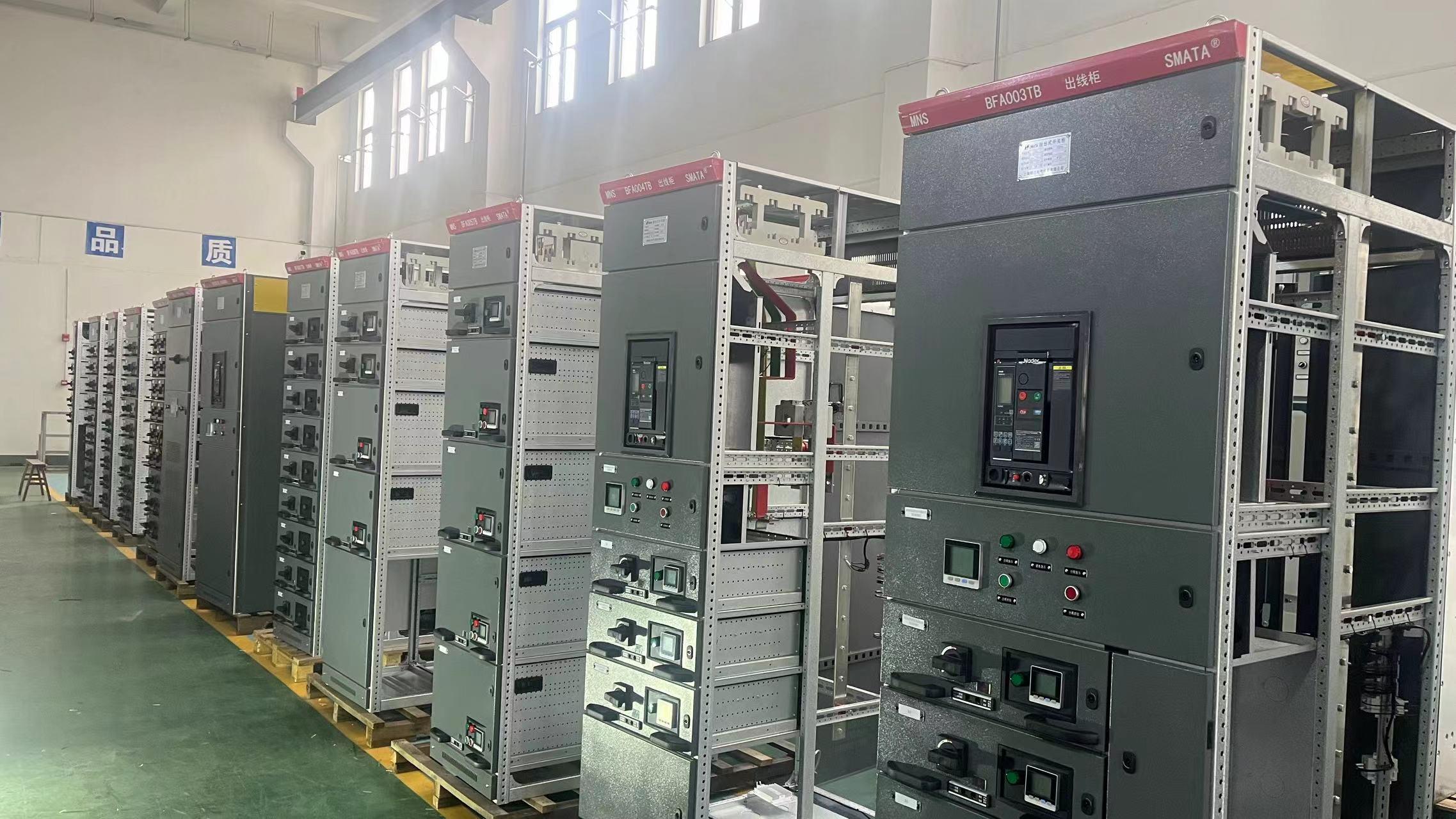
When a project calls for something beyond standard catalog parts, the real value lies in a supplier that can pivot from a high-current busbar assembly to a custom door latch without missing a beat. That kind of range rarely comes from a narrow product line. It comes from a shop floor built around mixed-batch workflows and engineers who understand both electrical clearances and mechanical fit tolerances.
On the busbar side, changes in laminate thickness, hole patterns, bend radii, or plating specs don't trigger a long re-quote cycle. We adjust the forming sequence and insulation placement to match the exact switchgear layout, then validate dimensions against the customer's own CAD before the first piece is punched. Small runs get the same attention as volume jobs, which is often what makes a prototype schedule hold together.
That same flexibility carries over to door hardware, where a custom hinge offset or a non-standard handle finish can be the difference between an enclosure that fits and one that gets reworked on site. Materials, thread forms, spring tension, and even packaging labels are treated as adjustable parameters rather than fixed options. The result is less time chasing multiple vendors and more time spent on the actual build.
Short-Circuit Ratings That Leave Margin for Growth
When sizing electrical systems, the short-circuit rating often becomes a line item that gets filled in with today's numbers and then forgotten. But treating it as a fixed ceiling overlooks how quickly real-world loads change. A panel that comfortably handles the fault current from last year's equipment can turn marginal after a single motor replacement or a new feeder run. Choosing ratings with built-in headroom means the protection scheme doesn't become the limiting factor when operations add another machine or reconfigure a production line.
The habit of specifying exactly what's needed, with no spare capacity, tends to backfire during routine upgrades. Each added branch circuit nudges the available fault current closer to the equipment's withstand limit, forcing either expensive retrofits or risky compromises. By contrast, gear rated above the calculated maximum gives the system room to breathe. It allows for higher interrupting duties without a full panel upgrade, keeping future changes from turning into a breaker coordination puzzle.
Another angle often missed is that margin itself acts as a safeguard against modeling errors. Utility fault levels can shift, transformer impedances vary from nameplate values, and motor contributions are easy to underestimate. A short-circuit rating with deliberate cushioning absorbs those unknowns instead of revealing them during a fault. That extra capacity isn't wasted money—it's a form of insurance that keeps the electrical infrastructure from being the bottleneck when growth arrives on short notice.
Form Separation That Simplifies Arc Fault Safety
Arc fault safety often gets tangled in the same physical space as power distribution, forcing designers to compromise between protection and accessibility. By pulling the arc fault detection circuitry away from the main current path, the protective logic no longer competes for board real estate or thermal budget. This physical separation lets each section be optimized independently—the power stage stays compact and efficient, while the sensing and trip mechanism can use slower, more precise components without exposing them to high dV/dt noise. The result is a design where arc fault response feels more like a quiet, dedicated watchdog than a bolted-on afterthought.
When the detection layer sits apart from the high-energy switching nodes, false trips drop noticeably. The sensing traces aren't fighting induced transients from adjacent inductors or snubber circuits, so the comparator thresholds can be set tighter without nuisance blinking. Maintenance also gets easier: a technician can probe the isolated arc fault module without shutting down the whole converter, and failed sensors swap out in minutes rather than requiring a board respin. That separation transforms a compliance checkbox into a practical serviceable subsystem.
Thermal and voltage stress no longer migrate into the arc detection circuitry, which means its reference drift over temperature stays predictable. You can place the protection module on a low-cost, low-layer-count PCB or even a flex tail, while the main power board uses heavy copper and aggressive cooling. This split also opens the door for retrofitting older equipment—adding arc fault safety becomes a matter of mounting a small daughter card and running a few sense wires, rather than redesigning the entire power path. The safety function remains isolated, testable, and surprisingly calm in the middle of high-power chaos.
Compact Drawer Units for Dense Motor Control Centers
In motor control centers where floor space is at a premium, compact drawer units replace traditional fixed bucket arrangements with a denser, service-friendly layout. Each drawer slides out on rails for inspection or swap-out without de-energizing the entire lineup, so a single faulty starter no longer means shutting down adjacent loads.
The drawer frames are built to accept multiple horsepower ratings within the same footprint, and keyed interlock plates prevent insertion of a mismatched unit. Spare drawers can be staged and exchanged in minutes rather than hours, cutting inventory and downtime during shift changes.
Thermal management is handled by front-to-back ventilation channels that route heat away from contactors and overload relays even when drawers are mounted side by side. Busbar stabs are silver-plated and spring-loaded to maintain positive contact under vibration, which helps keep hot-spot temperatures within the insulation rating in dense installations.
Global Compliance Without Local Redesign
Achieving compliance across multiple jurisdictions often forces teams to fork their codebase, creating regional variants that drift apart over time. A different approach keeps the core product untouched and moves jurisdiction-specific rules into a separate policy layer. This layer interprets the same user actions through country-specific filters for data retention, consent capture, and reporting obligations, so the underlying application never needs a local rewrite.
The key is treating regulatory differences as configuration rather than architecture. Tax calculations, age verification thresholds, invoice formats, and even language-specific disclaimers can be expressed as parameterized modules. When a new market opens, teams adjust a set of declarative rules and feature flags instead of rebuilding screens or overhauling database schemas. Automated test suites then validate each configured profile against real legislative requirements, catching gaps before launch.
This separation also simplifies maintenance. A single engineering team can ship one release train while legal and operations staff manage rule updates in a controlled interface. Because the product experience stays consistent, users in different countries still benefit from the same performance, design, and functionality—only the legally mandated differences surface locally. The result is faster market entry and far less technical debt than maintaining parallel versions.
FAQ
MNS switchgear uses a modular, withdrawable design that simplifies maintenance and lets you reconfigure feeders without a full shutdown. It handles high fault currents with tested busbar systems and offers good arc containment when paired with appropriate protective devices.
The design supports rear and front access configurations, variable compartment sizes, and custom busbar ratings. OEM partners can adjust panel widths, cable entry positions, and internal separation up to Form 4 to suit tight electrical rooms or retrofit projects.
Withdrawable functional units allow rapid replacement of breakers or motor starters without de-energizing the entire board. Interlocks reduce operator error, and optional arc-resistant features help contain incidents, so production can resume sooner after a fault.
Typical provisions include padlockable racking mechanisms, shutter systems that cover live parts when a unit is withdrawn, clear mechanical position indicators, and compartmentalized busbar zones. These reduce exposure during routine inspection or component replacement.
Many MNS assemblies can be specified with higher IP ratings, anti-corrosion treatments, and ventilated but filtered compartments. This makes them workable in cement plants, mining facilities, and other settings where dust and humidity are concerns.
An OEM can align the switchgear layout with single-line diagrams, integrate protection relays and metering you already use, and handle factory testing before dispatch. That reduces site commissioning time and avoids interface mismatches between panels and upstream equipment.
Routine tests include dielectric verification, continuity checks, mechanical operation of withdrawable parts, and functional checks of interlocks. Depending on the project, temperature rise or short-circuit type tests may be available from the original manufacturer's certified data.
Communication-capable breakers, multifunction meters, and I/O modules can be integrated into the compartments. Data such as current, voltage, power factor, and breaker status can feed a plant SCADA or energy management system via Modbus, Profibus, or Ethernet protocols.
Conclusion
MNS switchgear frames are built around a simple idea: a low-voltage assembly should never be the weak point in a continuous process. Copper busbars, bolted joints, and insulating supports are sized for 24/7 thermal cycling, so the gear handles rated current without de-rating tricks or hot-spot surprises. That same engineering carries into OEM flexibility—every compartment from main busbar to door latch can be specified, swapped, or re-terminated without cutting welded structural members. The result is a platform that adapts to different breaker brands, relay layouts, and control schemes without forcing a custom enclosure project.
Short-circuit ratings are not treated as a bare minimum. Withstand and breaking capacities are selected so that a future motor or feeder addition doesn't push the assembly past its tested envelope. Internal form separation up to Form 4b keeps arc faults from cascading between bus, device, and cable zones, which means a fault in one drawer stays local. For dense motor control centers, compact withdrawable drawer units pack more starters and feeders into the same footprint while still allowing a single person to rack out a unit. And because the design already aligns with IEC 61439 and other major regional standards, the same core layout can be shipped to multiple markets without re-engineering the bus system or re-testing the enclosure. That is what reliable low-voltage distribution looks like when OEM needs lead the design.
Contact Us
Contact Person: Hellen
Email: [email protected]
Tel/WhatsApp: 86-13634205622
Website: https://www.voltcabinet.com