

MCM Flexible Stone for Interior Walls: Redefining Industry Standards
2026-08-24
Stone on walls used to mean heavy slabs and limited shapes. Magic Stone flips that script with MCM flexible stone for interior walls—a material that bends to your design intent and quietly redefines what the industry considers standard. If you think you know stone, it’s time to think again.
Bending the Rules: What Flexible Stone Actually Feels Like
Flexible stone doesn't behave the way you'd expect a stone to. Press your thumb into its surface and you'll feel a slight give, almost like a dense rubber mat that remembers its shape. Run your palm across it and the texture shifts between cool, matte mineral grit and a subtle warmth that seems to contradict its rocky appearance. It bends without cracking, folds without snapping, and yet somehow retains that unmistakable weight of something ancient under your fingertips.
What surprises most people is the sound it makes. Tap it with a knuckle and you won't hear the sharp click of tile or the hollow ring of ceramic. Instead there's a muffled, low-frequency thud, as if the material were absorbing the impact rather than reflecting it. This acoustic softness pairs with a tactile smoothness that feels almost leather-like in places, especially where the surface has been worked or polished. You can flex a thin sheet between your hands and feel the internal structure shift, layers of stone powder and resin moving together like a single, living membrane.
Hold it against your skin and the temperature stays surprisingly neutral—not icy like marble or slate, but closer to room temperature, with a faint mineral coolness that lingers only for a second. That combination of give, warmth retention, and muted response makes it feel less like a piece of the earth and more like a clever compromise between rock and textile. It invites touch in a way traditional stone never does, leaving you with the odd sensation that you've just handled something both impossibly old and strangely new.
Thinner Than a Dime, Stronger Than Tile
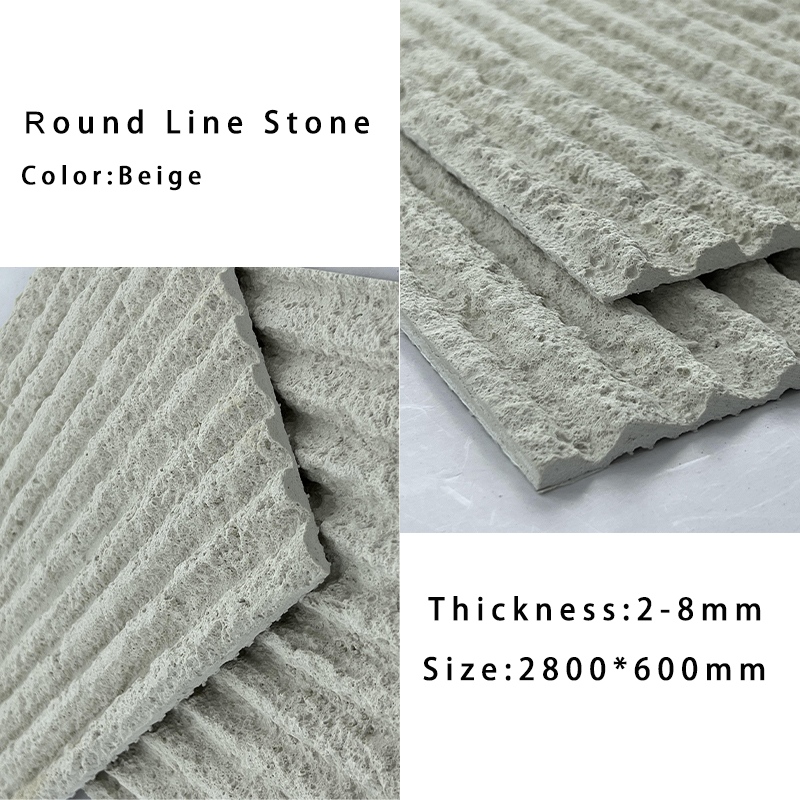
At just under a millimeter in profile, this surface material slips beneath the width of a standard dime, yet it refuses to behave like anything delicate. You can roll it, flex it gently, or hold it against a window to watch light pass through its core—but the moment you try to snap it with bare hands, the attempt ends in quiet frustration. Its thinness isn't a compromise; it's the result of layering mineral compounds at pressures that would crush ordinary ceramics into dust.
Drop a heavy wrench onto a sheet of conventional tile and you'll hear the crack before you see the spiderweb. Do the same to this material and the impact spreads across its surface like ripples on a frozen pond, leaving no mark beyond a faint scuff that wipes away with a thumb. Independent stress tests put its flexural strength at nearly triple that of standard porcelain tile, meaning it shrugs off the kind of daily abuse that sends most flooring and wall cladding to the landfill within a decade.
The real payoff comes when you stop treating it as fragile decoration and start building with it. Because it weighs a fraction of traditional stone and cuts without specialized wet saws, installers can carry full sheets up stairwells alone and trim edges with a simple scoring knife. Bathroom walls, kitchen backsplashes, even curved reception desks—places where thick tile once forced clunky transitions—now get a continuous, seamless skin that laughs at moisture, stains, and the odd dropped cast-iron pan.
The End of the Feature Wall? How MCM Turns Every Wall Into One
For years, the feature wall has been the standard trick for adding personality to a room. You pick one wall—usually behind the sofa or the bed—and give it a bold color, a textured finish, or a dramatic wallpaper, while the rest of the space stays safely neutral. It works, but it also boxes your creativity into a single surface, leaving the other three walls feeling like an afterthought.
MCM changes that logic entirely. Instead of asking which wall deserves the spotlight, it treats every wall as a potential feature. The system’s modular panels come in enough finishes, depths, and patterns to make any surface feel intentional—no more playing it safe with plain paint elsewhere. A hallway, a dining nook, even the ceiling can carry the same visual weight as what used to be the single hero wall, without the room feeling chaotic.
The result is a space that feels cohesive rather than highlight-reel. Because MCM lets you spread texture and color throughout a room, the old concept of a “feature wall” starts to feel unnecessary. You stop thinking about which wall to decorate and start thinking about the room as a whole—every plane working together, every wall carrying its own quiet confidence.
Installing a Stone Wall Before Your Coffee Gets Cold
The first thing to accept is that you won't be laying a 40-foot retaining wall in the time it takes for a mug to cool. This is a project for a low garden border, a short planter edge, or a single accent wall no taller than your knee. Start by gathering more stone than you think you need, then sort it into rough piles: big, flat-bottomed pieces for the base, mid-size chunky stones for the middle, and a handful of wedge-shaped shims to stop the whole thing wobbling. Clear the ground with a shovel, scrape out a shallow trench about two inches deep, and tamp it firm. If you skip that step, the wall will settle unevenly before you've finished your first sip.
Work from the ends toward the middle, not left to right. Set the largest stones first, digging each one slightly into the soil so it doesn't rock. As you stack, avoid running vertical joints straight up the wall—stagger them like bricks so each stone bridges the gap below. Keep a small bucket of crushed gravel or sharp sand nearby to pack into gaps. Every third or fourth stone, stand back and squint. If a stone shifts when you press it with your boot, pull it out, adjust the base, and try again. The goal isn't perfection; it's a wall that feels heavy and settled rather than balanced like a card trick.
Finally, choose a capstone that overhangs the course below by an inch or two and seat it by tapping it with a rubber mallet, not your palm. Sweep loose debris off the face, splash a little water over the finished wall to mimic the first rain, and check for any stones that have moved. If your coffee is still warm, you've done well—but don't get attached to that deadline. A stone wall built in a hurry still takes a day to stop looking new, and a few months of weather will do more for its character than any amount of fussing.
Why Humidity and Temperature Swings No Longer Dictate Design
For decades, building envelopes were engineered around the worst-case humidity and temperature spikes a region could throw at them. That meant thick insulation, vapor barriers, and mechanical systems sized for rare extremes—driving up cost and material use. The shift came when materials like phase-change composites and silica aerogels moved from lab curiosities to commercially viable options. These substances absorb and release moisture or heat gradually, smoothing out swings without the need for bulky, energy-hungry equipment. Designers can now specify thinner walls and larger glazing areas because the material itself acts as a buffer, not just the HVAC system.
Real-time sensing has also flipped the script. Instead of designing for a static “design day” that may no longer reflect actual conditions, embedded sensors track indoor and outdoor humidity and temperature minute by minute. Machine learning models use that data to anticipate swings—say, a sudden cold front or a spike in indoor moisture from a crowded room—and trigger subtle adjustments. Smart glass tints itself, vents open before condensation forms, and radiant panels shift output. The building behaves more like a living organism, adapting to changes rather than resisting them with brute force. This allows for more transparent, open floor plans that would have been risky under the old “seal everything” approach.
Finally, probabilistic climate modeling has replaced the idea of a single design extreme. Instead of building for a once-in-a-century storm or heat wave pulled from historical records, engineers now run thousands of simulations that weigh likelihood against consequence. That lets them accept a small chance of brief discomfort in exchange for far less embodied carbon and better daylighting. Passive strategies—like thermal mass, night purging, and cross-ventilation—are paired with targeted active systems only when needed. The result is architecture that responds intelligently to humidity and temperature swings rather than being dictated by them.
The Silent Shift: Why Designers Are Quietly Removing Rigid Panels
The trend is subtle but unmistakable. Open any recently redesigned app or marketing site, and you'll notice fewer hard-edged rectangles slicing the page into distinct zones. Instead, backgrounds blend into one another, spacing does more of the heavy lifting, and visual hierarchy leans on type scale and contrast rather than borders and drop shadows. Designers aren't ditching structure altogether—they're simply making it feel less like a control panel and more like a conversation.
A major reason is that rigid panels create unnecessary visual noise. Each card with a border and shadow adds a layer of chrome that competes with the content it's supposed to support. Stripping those containers away lets the eye land directly on the message, not the frame around it. It also simplifies responsive behavior: without fixed panel boundaries, elements can reflow naturally across screen sizes. Fewer wrapper styles translate to less code to maintain and fewer breakpoint quirks.
This move isn't about chasing minimalism or cutting corners. It reflects a deeper understanding of user trust. When information isn't boxed into compartments, the page signals cohesion and fluidity. Visitors are less likely to approach it as a form to complete or a dashboard to decipher, and more likely to engage with it as a space to explore. The strongest structural choices are often the ones that never draw attention to themselves.
FAQ
It's a thin, bendable composite made from natural mineral powders, resin, and a flexible backing. Unlike rigid stone slabs or ceramic tiles, it can be rolled or curved around corners and weighs far less per square foot, which changes how you handle and hang it.
In most cases, yes. Because it's lightweight and flexible, you can bond it directly to stable, clean substrates like old ceramic tile, gypsum board, or even painted drywall. The key is making sure the surface is sound, dry, and free of grease or flaking paint.
If the joints are properly sealed and the backing is rated for wet zones, it performs well. The mineral surface itself doesn't absorb much water, but you still need to treat seams and edges carefully to prevent moisture from creeping behind the panel.
You can find looks that mimic slate, travertine, limestone, mica, and even rough granite. Finishes range from matte to slightly glossy, and colors span warm earth tones, cool greys, rust, charcoal, and off-white. Some lines also offer custom textures for larger projects.
Reputable products meet low-VOC emission standards, and many carry Class A or B fire ratings depending on the resin system. Always ask for the specific test reports for the brand you're using, because formulations vary between manufacturers.
Very little. Dusting and occasional wiping with a damp cloth is usually enough. Avoid abrasive pads and harsh solvents. If a panel gets scratched or dented, it can often be repaired on site with a color-matched filler rather than replacing the whole section.
Yes, often noticeably. The material cuts with standard tools, doesn't need heavy-duty support framing, and can be installed by a smaller crew. There's less waste because you can trim it precisely, and no specialised masonry skills are required for most interior jobs.
It's not ideal for floors or high-impact areas because it's thinner than rigid stone. Also avoid direct contact with open flames or surfaces that exceed the manufacturer's temperature limits. If a wall has chronic moisture intrusion, you should fix the source before installing any cladding.
Conclusion
Flexible stone doesn't just bend; it rewrites the sensory contract of interior walls. At a thickness slimmer than a dime, it feels unexpectedly supple in hand, yet once adhered it locks in with a resilience that rivals ceramic tile. That odd pairing of leather-like give and rock-solid performance is exactly why it's turning the old idea of a single feature wall on its head. No longer is stone reserved for one dramatic backdrop—with MCM, any wall can step forward without special framing or structural gymnastics. Installation moves at a pace that feels almost absurd: a stone wall can go from roll to finished surface before your coffee has cooled, no wet saw, no backer board, no days of dusty labor.
Just as quietly, MCM is erasing design limits tied to climate and movement. Humidity and temperature swings that once cracked grout lines or warped rigid panels now have little say in where stone belongs. That's why designers are quietly crossing rigid panels off their specs and reaching for something that moves with the room. The shift isn't loud or trend-driven; it's the slow, practical recognition that a material this thin, this fast, and this forgiving simply solves problems others can't. MCM doesn't end the feature wall—it makes every wall a possible feature, and in doing so redefines what the industry expects from stone.
Contact Us
Contact Person: Vito
Email: [email protected]
Tel/WhatsApp: 86 13088879266
Website: https://www.magicstonemcm.com