

Leading Pillow Gel Pad Manufacturer for Ultimate Comfort and Cooling Support
2026-11-16
You know that sticky, restless feeling when your pillow traps heat instead of releasing it? The fix isn't another generic foam pad—it's a gel pad engineered by people who obsess over cooling support. Kunbao, a leading pillow gel pad manufacturer, has made that obsession its entire business. From gel density to airflow channels, every layer is built for one thing: ultimate comfort that actually lasts through the night. Here's what sets their approach apart.
What Actually Keeps a Gel Pad Cool Throughout the Night
That instant coolness when you lie down isn't a stored chill waiting in the pad. It's the gel's density doing the work. Because the material is far more conductive than foam or cotton, it pulls heat out of your skin quickly, making the surface feel cold. The pad doesn't create cold; it simply accepts your body's warmth faster than anything else on the bed.
For the coolness to last, the pad needs a place to dump that heat. A tightly sealed slab of gel would warm up and stay warm. The best pads use an open cellular structure or ventilated channels that let warm air drift away as you move. That slow, passive exchange is what keeps the surface from turning into a sticky warm layer by midnight.
Some pads go further by mixing in phase-change materials. These substances melt or soften right around typical skin temperature, soaking up extra heat during the transition. When your body shifts and the pressure eases, they re-solidify and dump that stored energy into the air. That subtle cycle is why a well-made gel pad can feel cool at 2 a.m. rather than just at lights-out.
How Gel Density Affects Support Without Added Bulk
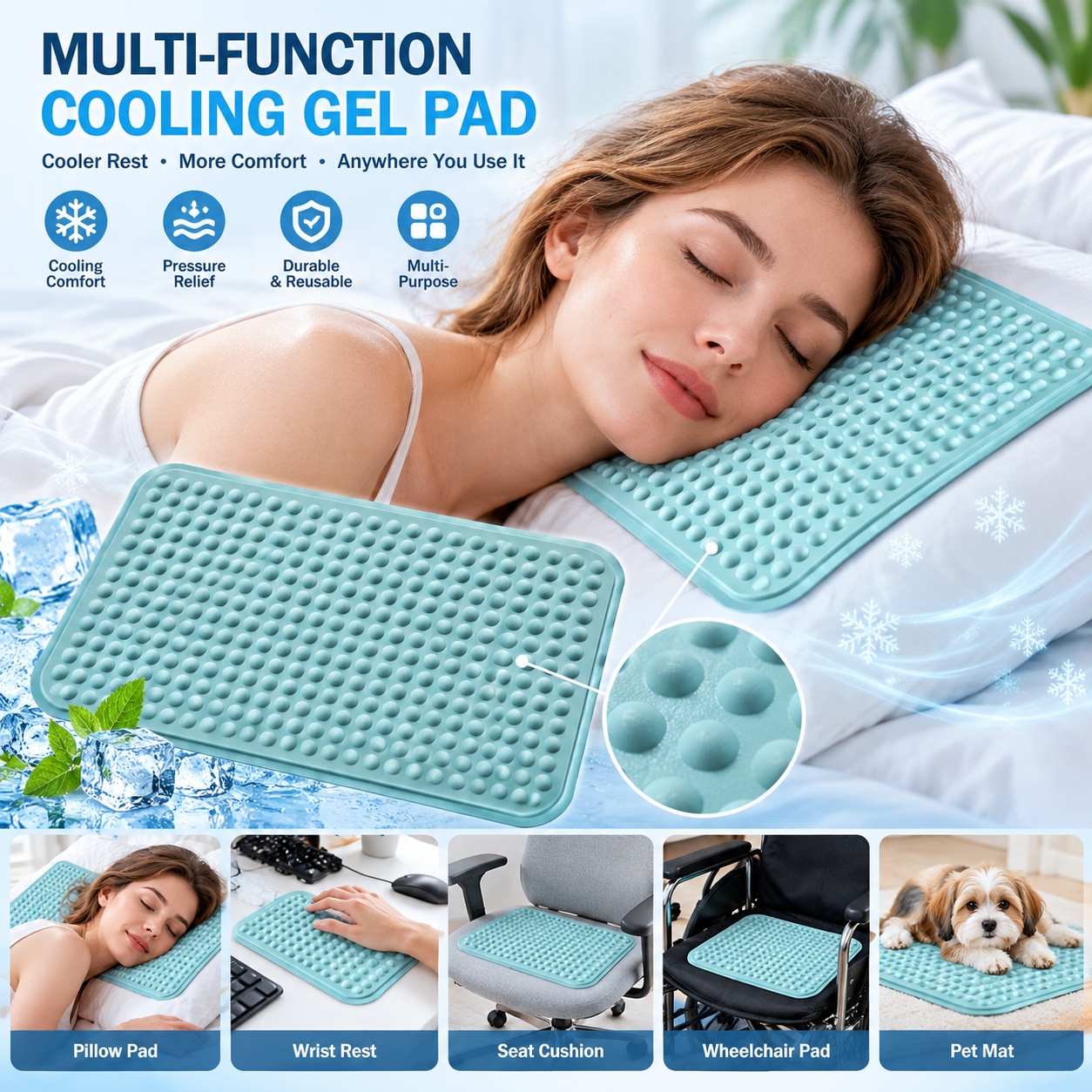
Gel density works behind the scenes to deliver support that feels present but never heavy. Rather than relying on extra layers or thicker foam, a denser gel distributes pressure more evenly across the surface. This means the body sinks just enough to feel cradled, while the material pushes back with a quiet firmness that keeps the spine aligned. The result is support that acts more like a steady hand than a rigid wall.
What often gets overlooked is how density changes the way load travels through the material. With a higher gel density, the internal structure has less empty space, so each square inch responds to weight with greater consistency. You get that locked-in feeling around the hips and shoulders without the mattress or cushion suddenly swallowing you. It’s a subtle shift—less sink, more surface contact—but it makes a noticeable difference for anyone who hates that “stuck” sensation.
The real advantage is that this kind of support doesn’t demand a thicker profile. You can keep the sleek, low-profile look while still getting targeted reinforcement where it counts. Because density does the work, designers can skip the bulky toppers and still achieve a sleep surface that holds its shape hour after hour. It’s support that stays out of sight, but you feel it the moment you lie down.
Inside the Manufacturing Steps That Preserve Gel Performance
A gel's final behavior is largely decided before the batch ever reaches a holding tank. Blending operators watch the torque curve from the mixer more closely than the clock: the moment the viscosity trace flattens, they stop adding shear. That point tells them the polymer network has absorbed enough energy to distribute cross-linker evenly, and pushing further only tears the forming matrix apart.
The curing room is where subtle mistakes surface. Racks are spaced to keep every cartridge at the same ambient temperature, and the air handler pulls moisture out rather than letting condensation settle on uncured surfaces. If humidity drifts above the narrow band written on the batch sheet, the outer layer cross-links faster than the core, leaving a gel that feels firm at the nozzle but sags under its own weight days later.
Once cure completes, the sorting step tests more than viscosity. Technicians squeeze a small bead onto a chilled plate and watch how it recovers after being cut with a spatula. That simple check catches gels that pass the spec sheet but fail in real loading conditions, because recovery speed depends on the same molecular entanglements that define thixotropy and slump resistance.
Matching Your Sleeping Position to the Right Pad Thickness
Side sleepers put the most direct force on their shoulders and hips, so a thicker pad—typically around three to four inches—keeps those points from bottoming out against the ground. If you wake up with numb arms or sore hip joints, your current pad is likely too thin for the way you sleep.
Back sleepers have it easier: a medium thickness of two to three inches usually supports the natural curve of the spine without lifting the head too high. Anything thicker can feel unstable, and you may notice your lower back tensing up overnight as your body tries to find balance.
Stomach sleepers need the least cushioning. A one- to two-inch pad keeps the hips from sinking too far, which helps prevent that morning lower-back ache. Go too thick here and your spine gets pulled into an uncomfortable arch, undoing the benefit of a good rest.
Why Material Choice Matters More Than Marketing Claims
A tag can promise durability, breathability, or sustainability, but the actual fiber, weave, and finish determine whether those promises survive a season of real use. Cotton blends stretch differently than pure linen. Recycled polyester might shed microplastics despite its green label. Coatings wear off, dyes fade, and stitching fails long before a brand updates its homepage. Choosing materials based on how they behave under stress—rather than how they sound in a campaign—separates gear that lasts from gear that merely launches well.
The gap between material and message shows up fastest in the details nobody photographs. A jacket with a waterproof rating can still soak through at the seams if the thread isn't sealed. A pair of boots made from 'premium leather' can crack within a month if the hide is corrected or split. When you ignore the spec sheet and pay attention to weight, grain, density, and how a fabric recovers after being crushed, you start to see why some products cost three times more without any logo to justify it.
Simple Care Habits That Prevent Gel Breakdown Over Time
Washing your hands right after a gel manicure isn't the best move. Give the polish a full day to settle before soaking it, and when you do wash up, use lukewarm water instead of hot. Hot water makes the gel expand and contract against your nail, which weakens the seal over time.
Keep cuticle oil nearby and apply it twice a day. Focus on the skin around the nail and the free edge where lifting usually starts. Well-moisturized cuticles flex with the nail instead of pulling away from the gel, so small cracks don't turn into peeling sheets.
Avoid using your nails as tools. Opening cans, peeling labels, or tapping hard surfaces puts uneven pressure on the gel and creates micro-tears that lead to breakdown. If you notice a small chip, resist picking at it. File the edge smooth or visit your technician for a quick patch instead of letting moisture get underneath.
FAQ
Our pads combine a medical-grade gel layer with a breathable mesh backing, so you get instant cooling without that sticky feel. We also add a subtle anti-slip texture that keeps the pad from shifting around at night.
They use a phase-change gel that draws heat away from your head and neck continuously. The open-cell design lets air circulate underneath, so warmth doesn't build up the way it does with memory foam.
Yes, we can cut the gel to nearly any outline and thickness you need. Just send us a drawing or a sample, and we will match it within a few millimeters.
All batches are tested for heavy metals, phthalates, and skin irritation. We also run a repeated compression test to make sure the gel won't crack or leak after years of use.
A quick wipe with mild soap and warm water is all it takes. The surface is sealed, so dust and sweat don't soak in, and you can air dry it in about fifteen minutes.
We usually work with a minimum of 500 pieces per design, but we can sometimes accommodate a 200-piece trial run for new partners. Let us know your target market and we'll figure out a plan.
Every roll of gel is inspected for thickness and cooling performance before it goes to the cutting line. Then we pull random samples from each shift for a final visual and compression check.
Absolutely. We can emboss your logo into the gel, print it on the mesh backing, and provide fully customized retail boxes or polybags.
Conclusion
A gel pad's all-night cooling comes down to how the material handles heat transfer. Instead of relying on a single cooling additive, a well-made pad uses a thermally conductive gel that pulls excess warmth away from the skin and disperses it through the pad's surface. Higher gel density improves this effect without creating a bulky pillow topper because the gel can be molded into a thinner, more uniform layer that still provides firm support. During manufacturing, precise pouring temperatures and slow curing times lock in that density and prevent air pockets that would weaken the structure. The result is a pad that keeps its shape and cooling performance over months, not just the first few nights. Your sleeping position also determines the right thickness: side sleepers generally need a pad around 0.6 to 0.8 inches to fill the gap between the neck and mattress, while back and stomach sleepers should choose something closer to 0.4 inches so the head isn't pushed too far forward.
Material selection is where many pads fall short. Choose a food-grade or medical-grade gel that is free of phthalates and other plasticizers—these chemicals make the pad feel soft initially but lead to yellowing, odor, and surface stickiness within a few months. A high-quality gel remains flexible and non-tacky without chemical softeners. Simple care habits prevent breakdown: wipe the pad with a damp microfiber cloth instead of submerging it, keep it out of direct sunlight, and let it air dry completely before placing it back on the pillow. If the pad has a removable cover, wash the cover separately on a gentle cycle. A manufacturer that controls each batch from raw polymer to final inspection can promise consistent cooling and support, because the pad's performance is built into the material itself, not added later with coatings that wear off.
Contact Us
Contact Person: Catherine Peng
Email: [email protected]
Tel/WhatsApp: +86-13434169510
Website: https://www.kbcoolgel.com/