

How a PVC Antistatic Flooring Company Keeps Your Workspace Safe and Static-Free
2026-09-10
Static electricity is an invisible enemy in many workplaces—one that can corrupt data, damage components, and even ignite flammable materials. Simply wearing antistatic shoes isn't enough when the floor itself generates a charge. That's why Lipin Floor focuses on one thing: PVC antistatic flooring engineered to keep your workspace safe and static-free. But how does it actually work, and what makes their approach different? Read on to find out.
Static Discharge Is the Hidden Culprit Behind Many Workspace Equipment Failures
Walk across a carpeted floor, reach for a metal doorknob, and you get that familiar zap. Now imagine that same tiny spark hitting a circuit board inside a printer, a docking station, or a lab instrument. Most people never connect that sudden equipment glitch to a static event that happened hours earlier, but the damage is often already done. Components can be weakened by a discharge far below what a person can feel, and the result is a device that fails weeks or months later for no apparent reason.
In workshops and offices where humidity drops or synthetic materials are everywhere, static buildup becomes part of the daily routine. Rolling an office chair across a vinyl mat can generate thousands of volts, and simply unrolling a roll of packing tape can create enough charge to disrupt nearby electronics. The tricky part is that the damage doesn't always show up as a dead device right away — sometimes it changes a resistor's value, corrupts a memory cell, or shortens the lifespan of a connector. Over time, those accumulated insults turn into intermittent faults that are notoriously hard to trace.
What makes static discharge so frustrating is how invisible and silent it is. You don't need to see a spark or hear a crackle for a component to be compromised. Even a discharge of 100 volts — far below the threshold of human sensation — can punch through a modern integrated circuit. That's why grounding straps, anti-static mats, and humidifiers are more than just accessories; they're cheap insurance against failures that would otherwise be blamed on poor manufacturing or bad luck. Once you start treating static as a real environmental hazard rather than a minor annoyance, many "unexplained" equipment problems begin to make sense.
Inside the PVC Antistatic Floor That Neutralizes Charges at the Point of Contact
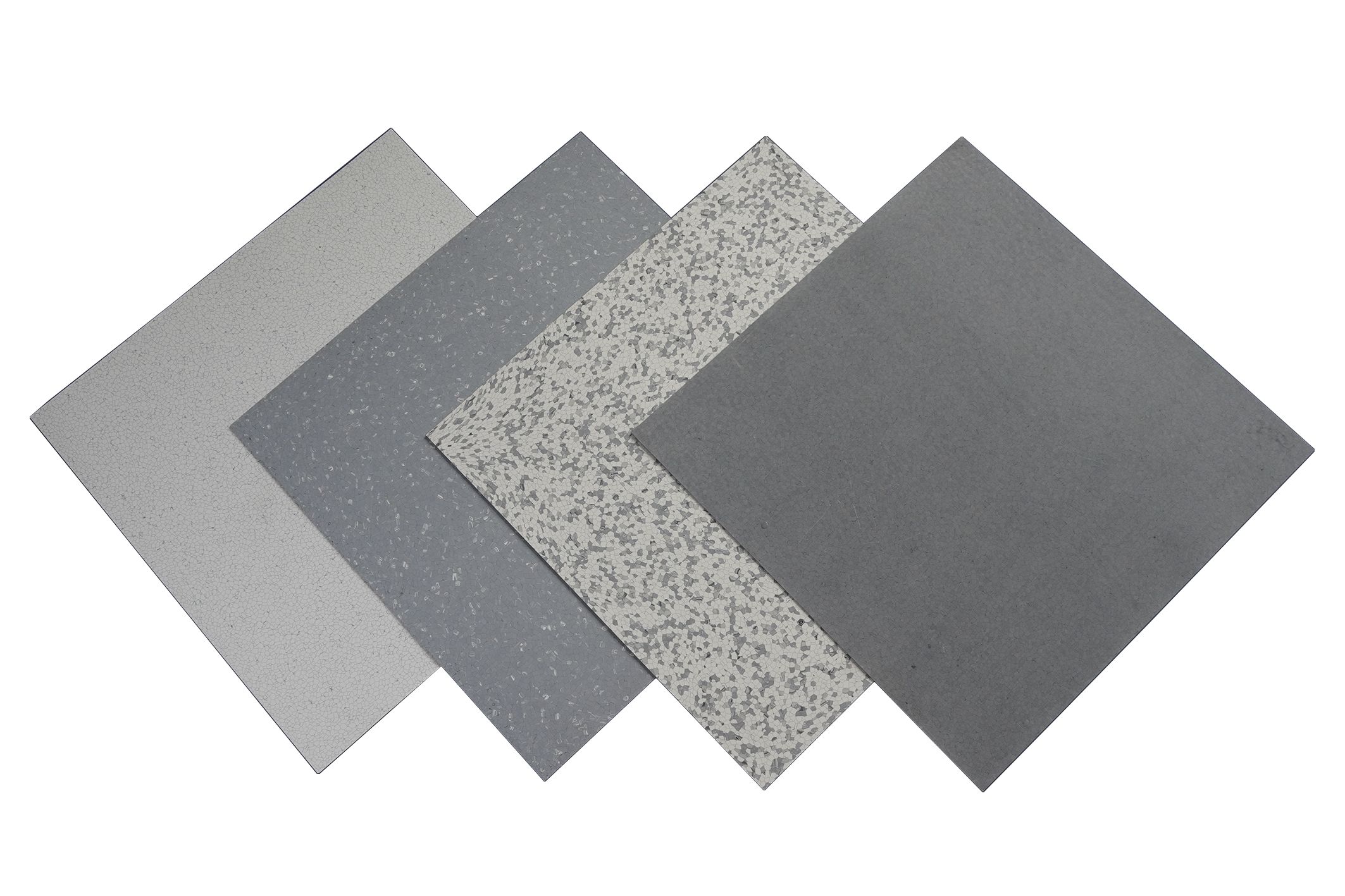
Standard PVC is an insulator, so a plain vinyl tile would let static linger rather than drain it. In an antistatic variant, the polymer matrix is loaded with a network of conductive additives—typically carbon powder, graphite flakes, or metal-coated fibers—that creates a controlled leakage path through the full thickness of the tile. This isn’t a conductive floor; it’s designed to sit in the dissipative range, usually between 10^6 and 10^9 ohms, so charge bleeds away slowly enough to avoid a sharp discharge but fast enough to prevent buildup.
The real neutralizing action happens right at the shoe-to-floor or caster-to-floor interface. As soon as a charged person or cart touches the surface, the local voltage pushes a tiny current through the top layer and into the buried conductive web. Because the contact point is small, the floor needs lateral conductivity too, not just vertical, otherwise the charge would pool around the footprint. Homogeneous PVC antistatic tiles solve this by distributing conductive particles evenly throughout, so there’s no weak direction.
Under the tiles, a grid of copper or aluminum tape ties each panel to a common grounding bus. Installers often use a conductive adhesive or primer so the underside connection isn’t broken by a resistive glue line. In practice, a properly grounded PVC antistatic floor will pull a 5 kV body charge down to under 100 V in a fraction of a second, which is well below the threshold that damages sensitive electronics or ignites solvent vapors.
The Grounding Step Most Flooring Projects Get Wrong and What It Costs You
Most flooring failures don't start with a bad plank or an uneven subfloor—they start with a skipped conversation about static electricity. The grounding step, often dismissed as an electrician's afterthought, is actually the first line of defense against equipment malfunctions, data corruption, and even painful micro-shocks for anyone walking across a newly finished room. When installers rush to lay planks without verifying that the underlayment and subfloor are properly bonded to a verified earth ground, they unwittingly turn the entire floor into a giant capacitor.
The costs show up quietly at first: a server rack that throws random errors only on dry winter days, a medical cart that resets mid-route, or a laser-guided cutting tool that drifts a millimeter off spec every few hours. These aren't dramatic failures—they're chronic, cumulative drains on productivity and trust. And because the symptoms mimic other issues, teams waste weeks chasing firmware updates, cable swaps, or humidity controls while the real culprit remains buried under the flooring. By the time an auditor traces the fault to a missing grounding lug or an oxidized copper strip, the project is already over budget and behind schedule.
Correcting it after the fact means pulling up sections, re-terminating bonding points, and often replacing underlayment that was never rated for conductive continuity in the first place. The labor alone can triple the original installation cost. The smarter approach is to treat grounding verification as a non-negotiable checkpoint before the first row goes down—test the resistance path, confirm the subfloor connection, and document the reading. That five-minute check protects not just the floor but everything that runs on top of it.
Day-to-Day Care That Keeps a Static-Free Floor Performing Like New
A quick daily sweep with a microfiber dust mop picks up the fine grit that dulls the surface and invites static buildup. You don't need harsh chemicals or heavy scrubbing—just a dry pass in high-traffic zones keeps the conductive properties intact and the finish looking crisp.
For spot cleaning, use a pH-neutral cleaner diluted with water and a well-wrung damp mop. Avoid oil-based or wax products; they leave a residue that insulates the floor and interferes with its static-dissipating performance. After mopping, let the floor air dry completely before walking on it.
Every few weeks, check the grounding connections and give the floor a deeper clean with a dedicated static-control floor cleaner. This removes stubborn contaminants without compromising the surface. With consistent, simple care, the floor stays safe, shiny, and ready for sensitive environments.
Matching Static Dissipation Specs to the Conditions Your Industry Actually Faces
Static dissipation requirements rarely map neatly from a datasheet to the factory floor. A specification that looks ideal on paper may fall short when humidity drops, when operators move faster, or when the material sits against a different substrate. The key is to stop treating surface resistivity as a fixed number and start treating it as a range that must hold under the specific environmental and mechanical stresses your process actually produces.
For electronics assembly, a work surface rated at 10⁶ to 10⁹ ohms may perform perfectly in a climate-controlled room at 40% RH. Move that same bench to a dry packaging area where winter humidity sits near 15%, and the dissipation time can triple, leaving sensitive components exposed to charge buildup. Rather than chasing a single "safe" value, map the worst-case humidity, temperature swings, and contact pressure your team encounters. Then choose materials whose dissipation curve stays inside the acceptable window across that full envelope, not just at one test point.
Grounding paths matter just as much as the mat or flooring itself. A dissipative floor that meets spec in isolation can become an insulator if installed over non-conductive adhesive or if the copper grounding strip corrodes after six months of washdowns. Pull real failure data from your own lines: where do ESD events actually occur, what shoes or casters are in use, and how often is the surface cleaned with which chemicals? Those operational details, not the lab report, should drive the final specification.
A Safer Workspace Also Means Fewer Repair Bills and Less Downtime
When tools get knocked off benches or cables are left snaking across walkways, the first casualty is often the equipment itself. A tidy, well-organized shop floor keeps impact damage and electrical shorts from turning minor incidents into major expenses. By securing heavy items on lower shelves, using cord wraps, and marking clear paths, you cut the number of dents, cracked housings, and frayed wires that quietly drive up your repair budget.
Downtime rarely comes from a single dramatic failure. More often it's the slow drip of small mishaps—a dropped drill bending a chuck, a forklift clipping a control panel, a spilled solvent corroding a connector. Each one sends a machine offline for hours or days. Safety-focused layout and housekeeping remove those triggers at the source, keeping every piece of equipment running longer between service calls.
There's also the hidden cost of rushed work. In a cluttered or hazardous space, technicians move carefully, recheck their surroundings, and sometimes stop entirely to clear debris. That hesitation adds up across a shift. A workspace designed for safe, natural movement lets people stay in flow, which means fewer idle spindles, fewer restarts, and fewer surprise invoices at month's end.
FAQ
It comes down to the material blend. During manufacturing, conductive particles like carbon or graphite are mixed throughout the PVC. That gives the floor a controlled electrical path, so any static charge from foot traffic or equipment flows through the tiles and into a copper grounding strip instead of building up on the surface.
Yes, and this is where many projects go wrong. The tiles themselves can be perfect, but if the seams aren't heat-welded or the copper grounding tape isn't properly connected to earth, the whole system fails. A proper install treats the floor as one continuous conductor, not just a bunch of individual tiles.
For the most part, yes. The antistatic properties live in the core and the backing, not just the top layer. Heavy rolling loads will wear down the surface over time, but that won't immediately kill the static control. The real risk is waiting too long to restore the wear layer, because once the conductive core gets physically damaged, repairs get much harder.
Keep it clean and keep it conductive. Use a dedicated antistatic cleaner that won't leave a film, and never apply wax or polish. Those products create an insulating layer that blocks the static path. Also, test the floor's resistance at least once or twice a year to catch any problem before it becomes a safety issue.
Very much so. If you're handling microelectronics, circuit boards, or anything sensitive to electrostatic discharge, this flooring acts as your first line of defense. It gives static a safe route to ground, which reduces the chance of a sudden discharge damaging a component. Just remember it works best alongside grounded workstations and wrist straps.
The main difference is that a specialist treats static control as the priority, not an afterthought. They'll check the grounding points, measure the floor's resistance with a megohmmeter, and make sure the installation meets industry ESD standards. A general flooring contractor might give you a smooth, nice-looking floor, but you'll have no idea if it actually dissipates static until something fails.
Often you don't. Static problems are usually localized to a broken seam, a lifted tile, or a damaged grounding wire. Those can be repaired without ripping up the whole floor. A good company will start with a resistance test around the problem area and only recommend full replacement if the conductive core has failed across a large section.
In a typical busy facility, you can expect about 10 to 15 years from antistatic PVC. The visible surface might need buffing or a new wear layer after several years of heavy traffic, but the conductive core underneath often stays functional much longer. Maintenance and cleaning habits make a big difference in how long that performance holds.
Conclusion
Many workspace failures trace back to something invisible: static discharge. It quietly damages sensitive electronics, disrupts operations, and shortens equipment life. A PVC antistatic flooring company addresses this by embedding conductive materials into the floor itself, so charges are neutralized at the point of contact rather than building up until they arc. The floor's effectiveness, however, depends heavily on proper grounding—one of the most overlooked steps in installation. Without a correct connection to earth, even the best antistatic surface becomes just another vinyl floor. That single mistake can lead to repeated equipment malfunctions and costly replacements.
Beyond installation, daily care plays a major role in keeping the floor static-free. Simple routines like using pH-neutral cleaners and avoiding wax or sealants preserve the floor's dissipation properties. It's also crucial to match the floor's resistance range to your actual work environment—whether it's a data center, a cleanroom, or a manufacturing line with moving personnel. When these details align, the payoff is twofold: a safer workspace with fewer static-related incidents, and significantly lower repair bills plus less downtime. That's how a PVC antistatic flooring company turns a static-free floor into a long-term operational advantage.
Contact Us
Contact Person: yuki
Email: [email protected]
Tel/WhatsApp: +86 18664390732
Website: https://www.lipinfloor.com/