

Cylinder Head Factory Advanced Casting and Machining Processes Explained
2026-09-22
Have you ever wondered what separates a standard cylinder head from one that survives extreme combustion pressure and thermal cycling? At DDR's advanced foundry and machining floor, the answer lies in a tightly choreographed sequence of casting and precision metal removal—where every pour, every cut, and every micron-level tolerance check is engineered for durability. This post walks you through the key stages, from molten metal to finished component, revealing why not all cylinder heads are created equal.
Choosing the Right Alloy and Keeping It Clean Before the Pour
Alloy selection starts with the casting method and what the part actually needs to survive. A sand-cast aluminum piece that gets machined later won't behave like a zinc die-casting filling thin walls, and picking an alloy just because it's common usually leads to porosity or cracking. Check the fluidity, solidification range, and how it reacts with the mold material before committing.
Cleanliness matters more once the metal is molten. Dross, slag, and dissolved hydrogen don't just disappear—they end up as inclusions or gas bubbles in the finished pour. Skim the surface regularly, use a degassing tablet or inert gas flush for aluminum, and keep tools and crucible free of rust or moisture. Even a small amount of contamination changes the grain structure and weakens the part.
Right before the pour, let the melt settle and bring it to the target temperature without overheating. Overheated metal picks up more gas and oxidizes faster, so a stable, quiet transfer into the mold works better than a rushed one. A clean alloy at the right temperature fills details cleanly and leaves less cleanup work after shakeout.
Building Cores That Define Water Jackets and Intake Ports
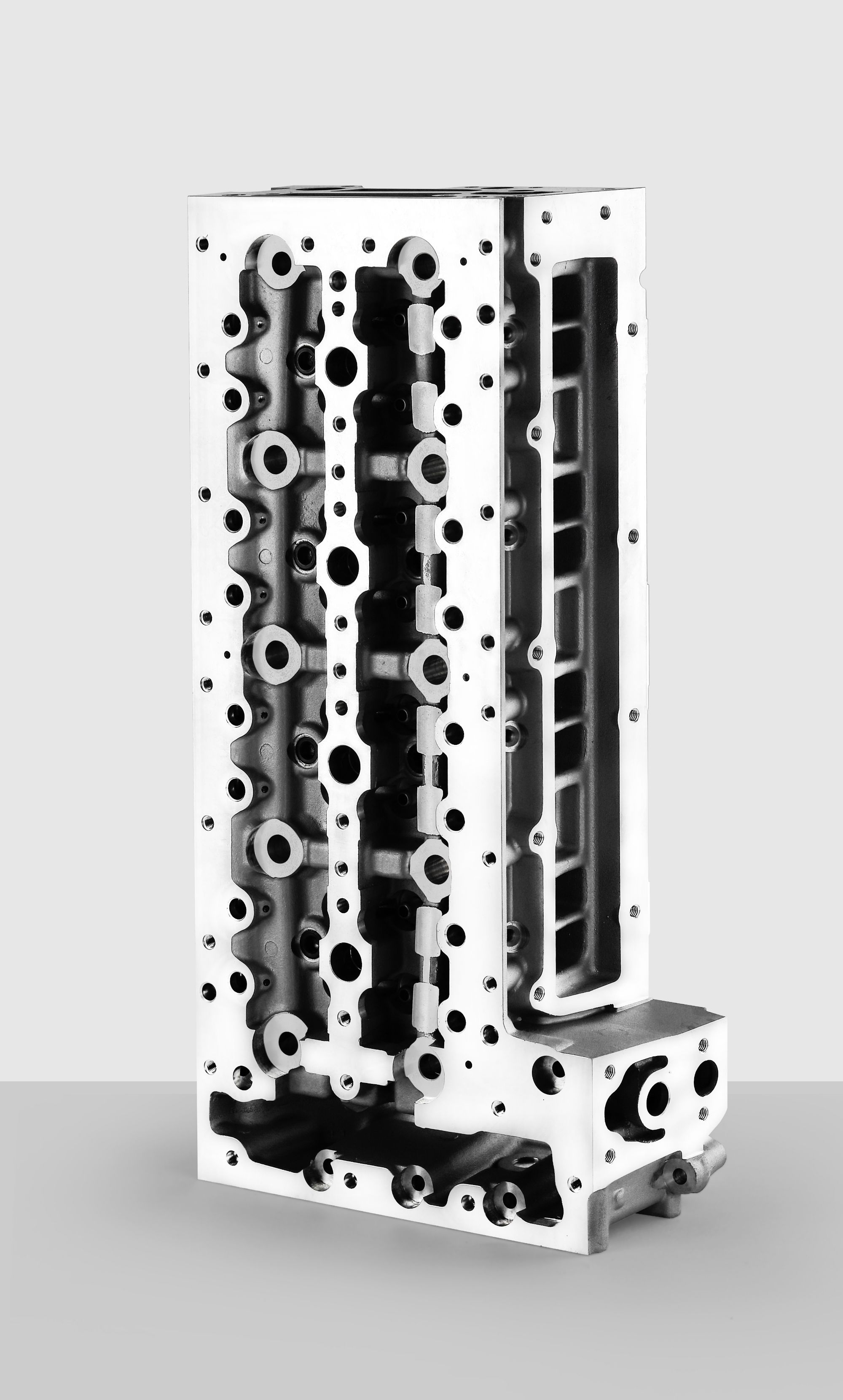
In sand casting, the internal passages of an engine block or cylinder head don't come from the mold itself but from separate sand cores placed inside before pouring. Water jacket cores create the thin, winding spaces around cylinder bores where coolant flows, while intake port cores shape the pathways that deliver air or air-fuel mixture to the combustion chamber. These cores must survive molten metal at over 1,300°C, resist buoyancy forces, and then break down cleanly during shakeout so the finished casting has clean, dimensionally accurate voids.
Building these cores starts with high-strength sand mixtures, often silica or zircon sand bonded with phenolic urethane or inorganic binders. The sand is blown or shot into core boxes under pressure, then cured either with amine gas or heat. Because water jacket cores are long, slender, and surrounded by metal on multiple sides, they need internal reinforcement—usually steel or cast iron chaplets or vents—to keep them from floating or shifting when the metal hits. For intake ports, the core surfaces must be exceptionally smooth to reduce turbulence and carbon buildup, so a refractory coating is applied and baked on.
Modern foundries often build these cores as modular assemblies, gluing smaller core segments together with core paste and checking final dimensions with coordinate measuring machines or laser scanners. This assembly approach allows intricate undercuts and variable wall thicknesses that would be impossible with a single solid core. The result is a casting where every water jacket gap and intake port curve matches the design intent tightly enough to support efficient cooling and airflow.
Low Pressure Casting and Directional Solidification for Dense Heads
Low pressure casting fills the mold from below, using controlled gas pressure to push molten metal up through a riser tube. This steady, non-turbulent flow minimizes oxide entrapment and gas porosity—common flaws in gravity pours. For dense heads, the result is a cleaner melt delivery that reduces inclusions and ensures a more uniform fill, especially in complex geometries where blind spots and thin sections are prone to misruns.
Pairing this with directional solidification shifts the freezing pattern from random to deliberate. Heat is extracted through strategically placed chills or mold geometry so the solidification front advances from the far end of the head back toward the riser. This maintains a continuous feed path for liquid metal, eliminating shrinkage voids that would otherwise appear as micro-porosity in the thickest sections. The outcome is a head casting with consistently dense microstructure, free from the scattered porosity that weakens fatigue resistance.
What makes this combination stand out in production is its repeatability. Unlike high-pressure methods, low pressure casting allows finer tuning of fill rate and holding pressure during solidification. Operators can adjust the pressure curve to match the thermal profile of a specific head design, achieving densities that rival forged billets without the secondary processing. It is a practical route for jobs that demand leak-tight, high-integrity heads in medium to large volumes.
Heat Treatment Cycles That Relieve Stress and Unlock Strength
Most people assume heat treatment is just about making metal harder, but the real magic often lies in the cooling curve. A well-designed stress-relief cycle doesn't just prevent warping or cracking—it rearranges the internal grain structure so the material can carry more load without becoming brittle. The typical approach involves a slow ramp to a temperature just below the lower critical point, holding long enough for dislocations to rearrange, then cooling at a controlled rate that avoids introducing new residual stresses.
Where this gets interesting is when you combine stress relief with a secondary aging or tempering step. For example, a two-stage cycle that first relaxes machining-induced tension, then re-precipitates fine carbides, can unlock strength that a single high-temperature soak would actually destroy. The key is understanding that stress relief isn't a single recipe—it's a tuning process. Over-soak and you lose hardness; under-soak and the part still carries hidden internal loads that will show up as dimensional drift weeks later.
In practical terms, the best cycles are often the ones that look almost too gentle on paper. A 50°C per hour ramp to 600°C, a hold that scales with section thickness, and a furnace cool to 300°C before opening the door can outperform a faster, hotter cycle in real-world fatigue testing. That's because the goal isn't just to erase stress—it's to leave the material in a state where the remaining stress gradients work in your favor, not against you.
Machining and Honing Critical Surfaces to Micron Tolerances
Achieving micron-level geometry on bores and faces starts long before the hone touches metal. Rough machining sets the stage: if tool pressure, thermal drift, or fixturing introduces even a few microns of lobing or taper, no amount of honing will fully correct it without sacrificing size. Shops that hold tight tolerances consistently tend to machine with sharp, dedicated inserts, take light finishing passes, and let parts normalize before measurement.
Honing then becomes a controlled correction rather than a bulk stock removal step. On a Sunnen or equivalent vertical hone, stone pressure, stroke length, and dwell at reversal are adjusted until roundness and straightness fall within a narrow band—often under 2 microns. Operators read the crosshatch pattern as a clue: an even 45-degree crosshatch with no flat spots usually means the bore is round and the stones are cutting evenly. Small adjustments to stroke position can pull taper out without changing size.
Verification loops matter as much as the cutting itself. Air gauging, bore micrometers, and in-process plug checks are common, but the real discipline is checking parts at the same temperature every time and correlating honing passes with actual stock removal. A logbook helps. Over time, machinists learn when to stop honing not by a dial alone, but by how the stones sound and how the part feels—tight tolerances become a feel as much as a number.
Leak Testing and X-Ray Inspection Before a Head Leaves the Factory
Every cylinder head that comes off the line gets a thorough leak test before it's allowed anywhere near a shipping crate. We pressurize the water jackets and intake ports with air, then watch the gauges for any pressure drop that would expose a porous casting or a bad valve seat. It's a simple check, but it catches the kind of flaws that only show up after the engine's been heat-cycled a few dozen times.
After the leak test passes, the head moves under the X-ray. This isn't a quick snapshot; we scan the critical areas around the combustion chambers and bolt bosses, looking for internal cracks or trapped sand that machining might have missed. The images get studied by a real person, not just a software flag, because some defects hide in the grain of the aluminum. Only when both tests come back clean does the head get stamped and packed for shipment.
FAQ
High-performance heads often start with low-pressure or gravity casting, but many factories now use precision sand cores to shape complex water jackets and intake ports. Low-pressure filling reduces turbulence and oxide formation, while directional solidification helps push porosity toward non-critical areas.
Most lines rely on multi-axis CNC machines with in-process probing that measures each critical bore after cutting. The machine can automatically offset tools for the next part, and some setups use temperature-compensated spindles to keep dimensions stable despite shop floor thermal swings.
Raw castings hold internal stress from uneven cooling. If you machine them right away, material can shift and ruin flatness or bore alignment. Factories typically run a thermal stress-relief cycle or let castings rest in a controlled staging area so they stabilize before finish cuts.
Simulation software models mold filling and solidification before the first physical pour. Engineers use it to predict shrinkage porosity, hot spots, and air entrapment, then adjust gating or add chills. This reduces trial-and-error and helps get a solid casting on the first or second run.
Water jacket cores are usually made in cold-box core shooters with tight sand control and coated with a refractory wash to resist molten metal erosion. The core prints and chaplets must hold the core precisely in place, because any shift changes wall thickness and can create hot spots or thin sections.
Beyond dimensional inspection, many factories use pressure decay testing on water jackets and CT scanning on a sample basis to find internal voids. Dye penetrant or fluorescent penetrant inspection catches surface cracks in combustion chambers and between valve seats.
Common choices include A356 or 319-type alloys, often heat-treated to T6 or T7 depending on the application. Some facilities add copper or magnesium adjustments to improve high-cycle fatigue life, and they control grain refinement during melting to get consistent mechanical properties across batches.
Deck surfaces are typically rough-milled, then finish-milled or ground to a controlled surface finish. Flatness within a few microns is critical for head gasket sealing, especially on turbocharged engines where thermal expansion and cylinder pressure try to lift the head.
Conclusion
Making a cylinder head that survives combustion pressure and thermal cycling starts long before molten metal enters a mold. The foundry team carefully selects an alloy—usually an aluminum-silicon grade for passenger vehicles or a high-strength cast iron for heavy-duty diesels—and keeps it degassed and free of oxides until the pour. Meanwhile, core makers assemble precisely shaped sand or salt cores that will form the water jacket and intake ports. These cores must interlock with the outer mold within a fraction of a millimeter, or wall thickness drifts and coolant passages leak. Once everything is set, low pressure casting feeds the metal upward into the mold, and directional solidification is managed through chills and riser placement so the head freezes from the combustion face backward, pulling shrinkage into the sprue rather than leaving porosity between valve seats.
After shakeout and riser removal, the rough casting goes through a heat treatment cycle—solutionizing, quenching, and artificial aging for aluminum, or a stress-relief anneal for iron—to unlock its mechanical properties without warping the deck. Then CNC machining centers mill the head face, bore cam and valve guide locations, and hone valve seats and guide bores to micron-level tolerances. A single off-spec seat can cost horsepower or cause oil consumption. Before any head leaves the factory, it passes a pressurized leak test on the water jacket and oil galleries, followed by X-ray or CT inspection of high-stress areas between the combustion chamber and ports. Only a casting that holds pressure and shows no hidden shrinkage cracks gets the final stamp and ships to the engine line.
Contact Us
Contact Person: Shelly
Email: [email protected]
Tel/WhatsApp: 8613967667688
Website: https://www.yongyu.com/