

Cosmetic Packaging Containers Manufacturer Guide to Choosing the Right Supplier for Your Brand
2026-08-24
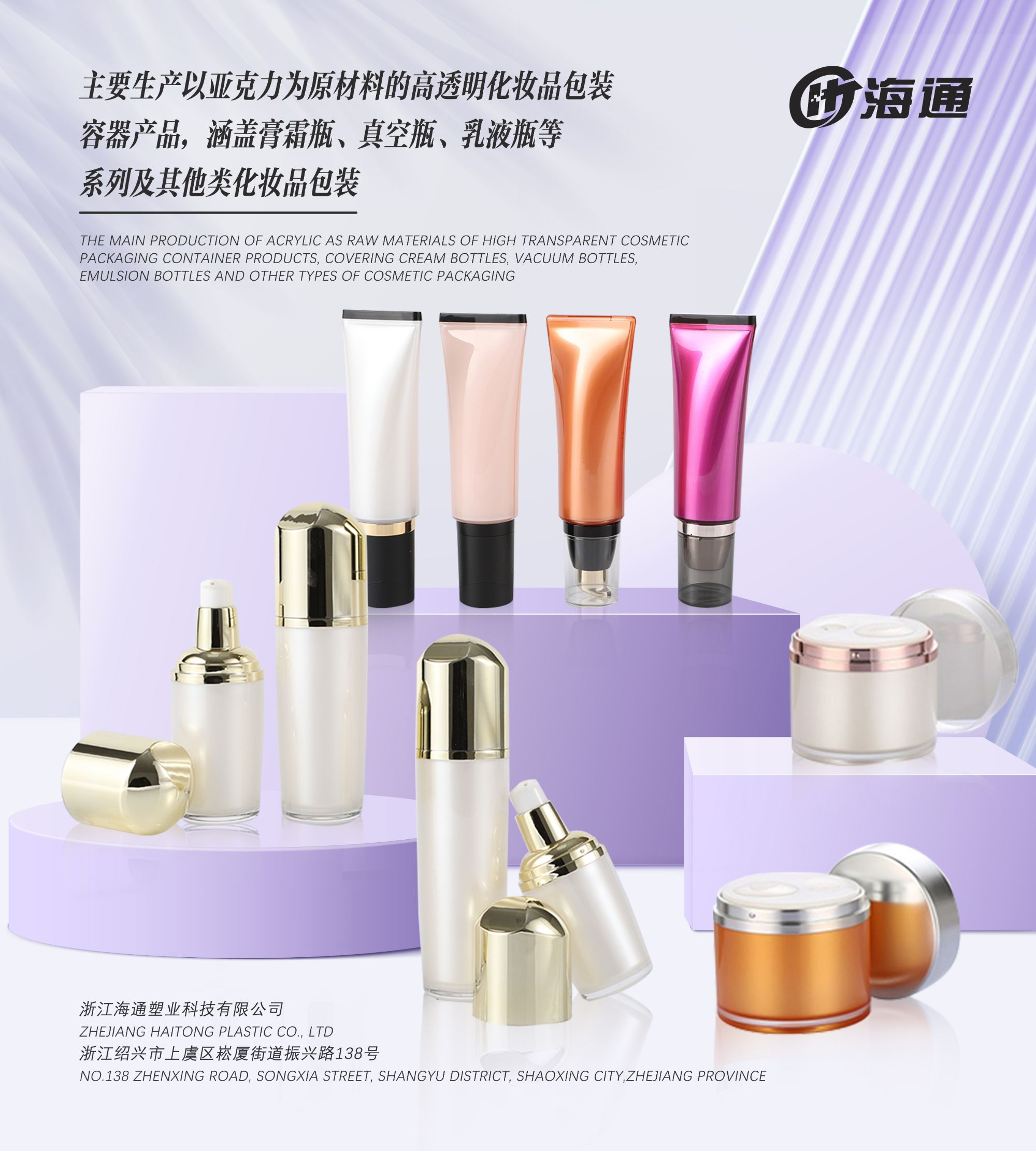
Most brand owners choose cosmetic packaging containers by sample kit alone—then wonder why the production jars feel flimsier than the prototype. This guide flips that approach. Instead of chasing the lowest unit price, we look at how a manufacturer like Zhejiang Haitong Plastic Industry Technology Co., Ltd. handles material consistency, mold maintenance, and tolerance control, so you can pick a supplier who won’t just match your render but your release deadlines.
Cosmetic Packaging Materials: Sorting Genuine Quality From Sales Pitch
The difference between a container that protects a formula and one that merely looks expensive often comes down to details suppliers rarely volunteer. “Airless” pumps, for instance, can still allow oxygen ingress if the piston seal tolerance is loose or the overcap fits poorly. Genuine quality shows up in dimensional consistency, not in the word “airless” printed on a spec sheet.
Material choice is another place where sales language drifts from reality. A “heavy glass” jar may feel substantial but can chip more easily than a well-engineered PETG alternative, while some acrylics develop stress cracks around the neck after repeated torque. Ask for chemical compatibility data with your specific formula—especially if it contains esters, volatile silicones, or high levels of fragrance—rather than accepting a generic “suitable for cosmetics” claim.
Finally, request evidence of batch-to-batch consistency. A sample can be flawless while production runs vary in wall thickness, neck finish, or coating adhesion. If a supplier refuses to share drop test results, migration testing, or tolerance sheets, you are likely paying for a story, not a material spec.
Production Capacity Checks That Save You From Launch Day Disasters
Most teams obsess over feature polish and marketing copy, but they skip the unglamorous work of verifying whether the production line can actually handle a surge. A capacity check isn't a load test you run once and forget. It means walking through every bottleneck with your ops lead, your backend engineers, and your warehouse manager—asking not just "can we make this?" but "can we make this when orders triple overnight?" One overlooked step, like a packaging supplier with a two-week lead time or a database that throttles after 5,000 concurrent reads, turns a successful launch into a refund frenzy.
Start with the physical realities before you touch code. If you're selling a physical product, sit down with the production floor and map out every node: raw material intake, quality control gates, pick-and-pack speed, shipping label throughput. Write down the slowest number—that's your true capacity, not the marketing slide's dream number. Then layer in the digital side: can your order management system sync inventory in real time, or will you oversell by 3 p.m. on day one? Team up with someone who has actually pulled an all-nighter fixing a production line, not just someone with a spreadsheet. They'll point out the obvious failure point you've been ignoring.
Finally, run a no-fanfare dry run with real orders from a small test group. Watch the handoffs. Where does the delay cluster? Which alert fires first? Document that, then fix the top three before you even think about launch day. The teams that survive launch days aren't the ones with the flashiest demo—they're the ones who know exactly how many units per hour they can actually move when it matters.
Customization Options That Go Beyond Sticking Your Logo On a Bottle
Real customization starts with the bottle itself, not just a printed logo. Think embossed glass patterns that catch light differently across a shelf, or a soft-touch matte coating that makes people want to pick the product up before they even read the label. These tactile and visual details create a first impression a flat sticker cannot match.
Closures and collars are another overlooked canvas. A custom-shaped cap, a bamboo lid, or a metallic collar with a subtle engraving can reinforce the brand story without adding clutter. You can also play with label materials—recycled cotton paper, transparent films, or heat-sensitive inks that reveal a second message when touched—turning the package into an interactive experience.
Even the inner packaging matters. Custom tissue wraps, seed-paper inserts, or molded pulp trays that echo the bottle's silhouette show attention to detail. These choices do more than decorate; they signal craftsmanship and make the unboxing feel intentional, which is what separates a forgettable product from one people keep on their counter.
Minimum Order Quantities: When Low Numbers Hide Higher Costs
A supplier might advertise a minimum order quantity of just 50 units, and that sounds like a low-risk way to test a new market. But dig into the fine print and you'll often find that the per-unit price at that volume is barely better than retail. The real cost hides in the gap between what you think you're saving and what you actually pay once shipping, handling, and the time spent managing tiny orders are factored in.
The trap is psychological: a small MOQ feels like a favor, a door left open for small buyers. Yet suppliers rarely lose money on such deals. They simply shift the burden elsewhere, through higher unit costs, inflated freight charges, or mandatory add-ons like custom labeling fees. Before you celebrate a low minimum, ask for the full landed cost at that exact quantity and compare it against a slightly larger order. Often, the difference is so small that you'd be better off buying a bit more and actually getting a usable margin.
Smart buyers treat MOQ as one variable in a cost equation, not a headline number. A supplier with a 500-unit minimum but transparent volume discounts may end up cheaper per sale than one offering 50 units at a premium. The low number isn't the bargain; the math behind it is.
Sample Evaluation: Spotting Defects Before They Become a Full Production Run
Getting a sample into your hands early isn't just a formality—it's the moment you can catch a misaligned seam, a weak joint, or a finish that doesn't match the approved swatch. These small mismatches rarely announce themselves in a spec sheet. They show up under real handling: a zipper that sticks on the third pull, a button that sits slightly off-center, or a coating that scuffs too easily when slid across a table. By putting the sample through its intended use before signing off, you turn a fragile assumption into a measured decision.
The value of sample evaluation multiplies when you test against the actual production environment. A prototype stitched by a senior machinist can hide inconsistencies that appear once the line runs at full speed with less experienced hands. Ask the factory to send a sample pulled from the pilot run, not a hand-finished one-off. Then check the obvious—dimensions, color, weight—but also the less obvious: how the material behaves after a few wash cycles, whether edges fray under tension, and if the packaging protects the product during a drop test. A defect caught here costs hours of rework; the same defect caught after a full run costs containers of returns.
Make your sample feedback specific enough to act on. Instead of noting “stitching looks off,” mark the exact spot on a photo or sketch, measure the deviation, and state the acceptable tolerance. Pair that with a clear yes/no on whether the sample can move to production or needs another round. This removes the guesswork for the supplier and creates a trail you can point to if the bulk order drifts. Spotting a defect before it scales isn't about being difficult—it's about protecting the time, money, and reputation already invested in the product.
After Delivery: The Real Test of a Cosmetic Packaging Supplier
The real test starts once the pallets are unwrapped and the first units hit the filling line. A component can look flawless in a pre-shipment photo but reveal its flaws under torque, humidity, or repeated use. Pumps that hesitate, caps that crack at the knurl, or an inner liner that peels away from the bottle mouth are not problems you want to catch after your product reaches a shelf. A supplier worth keeping sends retained samples from the same batch and checks in a few weeks later, not to chase a review, but to catch drift before it becomes a recall.
After delivery also exposes how a supplier handles friction. When a shade of coated glass comes in a half-tone off or a batch of compacts shows cloudy mirrors, the response tells you everything. Do they ask for photos and lot codes, or do they start shifting blame to the freight forwarder? The best ones quietly replace the defective pieces, cover the rework cost, and adjust the next production run without turning it into a negotiation. Cosmetic packaging is intimate; your customer touches it every day. Small defects are not small to them.
Reorders reveal consistency. A supplier can make one beautiful batch, but can they reproduce the same color, weight, and closure feel nine months later when your line is running again? The real test is remembering the tweaks: the slightly softer spring in the airless pump, the matte finish that was never quite matte enough, the tray insert that needed an extra millimeter. A dependable partner keeps that history and raises a flag if a raw material is changing, instead of letting you discover it on the loading dock.
FAQ
Focus on whether the manufacturer truly understands the specific demands of cosmetic packaging, such as material compatibility with your formula, seal integrity, and UV protection. Ask for real case studies of containers they have produced for similar product types like lotions, serums, or creams. Never choose based on the lowest quote alone.
Request recent third-party audit reports such as ISO 9001, GMP, or BRC certification. Ask them to send compatibility test samples using your actual formula. You can also conduct a live video factory tour and ask them to show in-line inspection processes and retained sample procedures on the production floor.
The most common error is overlooking long-term stability between the packaging and the formula. Many brands only care about appearance and unit price, then discover that the inner coating reacts with certain active ingredients or the pump mechanism is incompatible with the product texture, causing leaks or clogging. Always run accelerated aging tests for at least three months during development.
It is very important, but it depends on your order volume. If your minimum order quantity is small, choose a supplier with an existing mold library that allows color changes or surface treatments. If volume is high, prioritize a factory with in-house mold design and tooling capabilities. The key is to ask about mold modification costs and lead times rather than just hearing 'we fully support customization'.
Sustainability has shifted from a nice-to-have to a market entry requirement in many regions. You need to confirm whether the supplier can offer PCR (post-consumer recycled) materials, refillable inner cartridge designs, or mono-material solutions, and whether they can provide relevant environmental certifications or carbon footprint data. But be wary of greenwashing - insist on seeing actual certification documents.
Ask directly for production schedules and actual shipment records from similar orders over the past six months. Contact two or three brands they have served (not necessarily direct competitors) to ask about delays. Also require the supplier to commit to written confirmation dates for key milestones like mold completion, trial molding, and first mass production article, with clear penalty clauses for missed deadlines.
Do not send just a rendering. Attach a detailed technical specification: material, capacity, dimension tolerances, surface finish, printing requirements, filling method, and your formula ingredient list for compatibility evaluation. Also ask the supplier to provide three options: standard stock item, lightly customized, and fully customized, each with its own price and minimum order quantity.
Break down the cost into components: mold fee, unit price, minimum order quantity, logistics, and defect rate. Do not simply cut the unit price. Ask the supplier to quote different material grades such as virgin resin versus recycled resin, and clearly define an acceptable defect rate ceiling. Sometimes paying 5% more per unit to keep the defect rate under 2% results in a lower total cost overall.
Conclusion
Choosing a cosmetic packaging supplier goes far beyond comparing price sheets and catalog photos. Material claims are often the first place where brands get misled—what's marketed as premium glass or virgin PET can quietly become a lower-grade substitute under volume pressure. Insist on physical sample testing, not just spec sheets, and ask for batch-level material certifications before committing. Equally important is production capacity. A supplier that handles small pilot runs flawlessly may crumble when your launch requires tens of thousands of units in a tight window. Ask about dedicated lines, peak-season backups, and real lead times instead of optimistic promises.
Customization should mean more than adding a logo to a stock bottle. Look for manufacturers who can adjust neck finishes, wall thickness, color matching, and even design tooling from scratch—because those details shape how your product feels in hand and performs over time. Low minimum order quantities are often pitched as a benefit, but they can hide higher per-unit costs, longer delivery timelines, or shared molds that limit exclusivity. Always evaluate pre-production samples with a critical eye: check seams, threading, weight consistency, and closure fit before approving a full run. Finally, the real test comes after delivery. A supplier that responds quickly to defects, holds replacement stock, and takes ownership of quality issues is worth far more than one that disappears once the invoice is paid.
Contact Us
Contact Person: Kara Yang
Email: [email protected]
Tel/WhatsApp: 8618857568397
Website: https://www.haitongplastic.com/