

Cleanroom Equipment Company Highlights Top Considerations for Optimal Contamination Control
2026-09-02
The margin between a spotless cleanroom and a contamination event is often narrower than it looks on paper. Equipment decisions that seem minor during procurement can quietly shape airflow, cleaning protocols, and particle counts for years. GENO Pharmatech has been in enough cleanrooms to know that the best contamination control strategies share a few non-negotiable considerations—and they're not always the ones listed in product brochures. Here's a closer look at the factors their engineers treat as make-or-break, so your next equipment choice works with your environment instead of against it.
Airflow Design That Keeps Particles From Settling Where They Shouldn't
Effective airflow design begins with how particles actually move in a space. In many clean environments, particles settle not because filtration is poor but because airflow stalls. Maintaining steady, unidirectional movement—usually top to bottom or back to front—forces airborne debris toward returns before it can drop onto work surfaces. Velocities in the range of 0.3 to 0.5 meters per second tend to carry particles efficiently without creating the kind of turbulence that kicks settled material back into the air.
Vent placement and room geometry are just as important as velocity. Supply diffusers should align directly over sensitive zones, with returns located low and opposite to create a clean sweep across the area. Any large object placed in the path—racks, tables, even lighting fixtures—can create low-pressure pockets where particles linger and eventually settle. Where obstacles cannot be moved, perforated panels or adjusted air curtains can help smooth the flow and keep the intended pattern intact.
The only way to confirm that the system still works is to watch the air itself. Periodic smoke visualization or particle counting reveals changes that happen after equipment moves or doors are left open longer than expected. By verifying flow direction and adjusting damper settings, facilities can prevent the slow drift toward contamination that comes from particles finding quiet corners to rest.
Filter Media Choices That Match Your Cleanroom's ISO Class
Selecting the right filter media starts with your cleanroom's ISO class, because each class demands a different balance of particle capture, airflow resistance, and cost. For ISO 7 or ISO 8 spaces, a standard high-efficiency particulate air (HEPA) media with glass fiber or synthetic microglass often handles the load without overengineering the system. These materials trap the majority of airborne particles down to 0.3 microns while keeping pressure drop manageable, which matters when you're running fans around the clock.
Move into ISO 5 or stricter, and you'll need ultra-low penetration air (ULPA) media or advanced expanded polytetrafluoroethylene (ePTFE) membranes. These choices push capture efficiency past 99.999% for submicron particles, but they come with higher initial costs and often require stronger fan systems. A practical approach is to match the media's minimum efficiency reporting value (MERV) or EN 1822 rating to the actual particle challenge in your facility, not just the cleanroom's nominal class. This avoids both under-filtering and unnecessary energy waste.
Also consider how the media behaves over time in your specific environment. In semiconductor or pharmaceutical cleanrooms, outgassing from certain binders or moisture uptake in humid conditions can quietly degrade performance. Look for low-boron glass fiber or hydrophobic ePTFE if chemical compatibility or humidity swings are a concern. Ultimately, the best media choice aligns with your ISO class, the real-world particle sources in your process, and the long-term cost of ownership rather than just the rated efficiency on a spec sheet.
Low-Shedding Surface Materials for Every Critical Touchpoint
Many cleanroom failures trace back to something almost invisible: the slow release of particles from surfaces that get touched constantly. Door handles, equipment buttons, cart rails, and workbench edges all become points where abrasion breaks down ordinary finishes. Once a surface starts shedding, even slightly, it supplies a steady stream of contaminants that can compromise sensitive processes or patient areas. Choosing materials that hold together under repeated contact isn't just about durability—it's about controlling what ends up in the air.
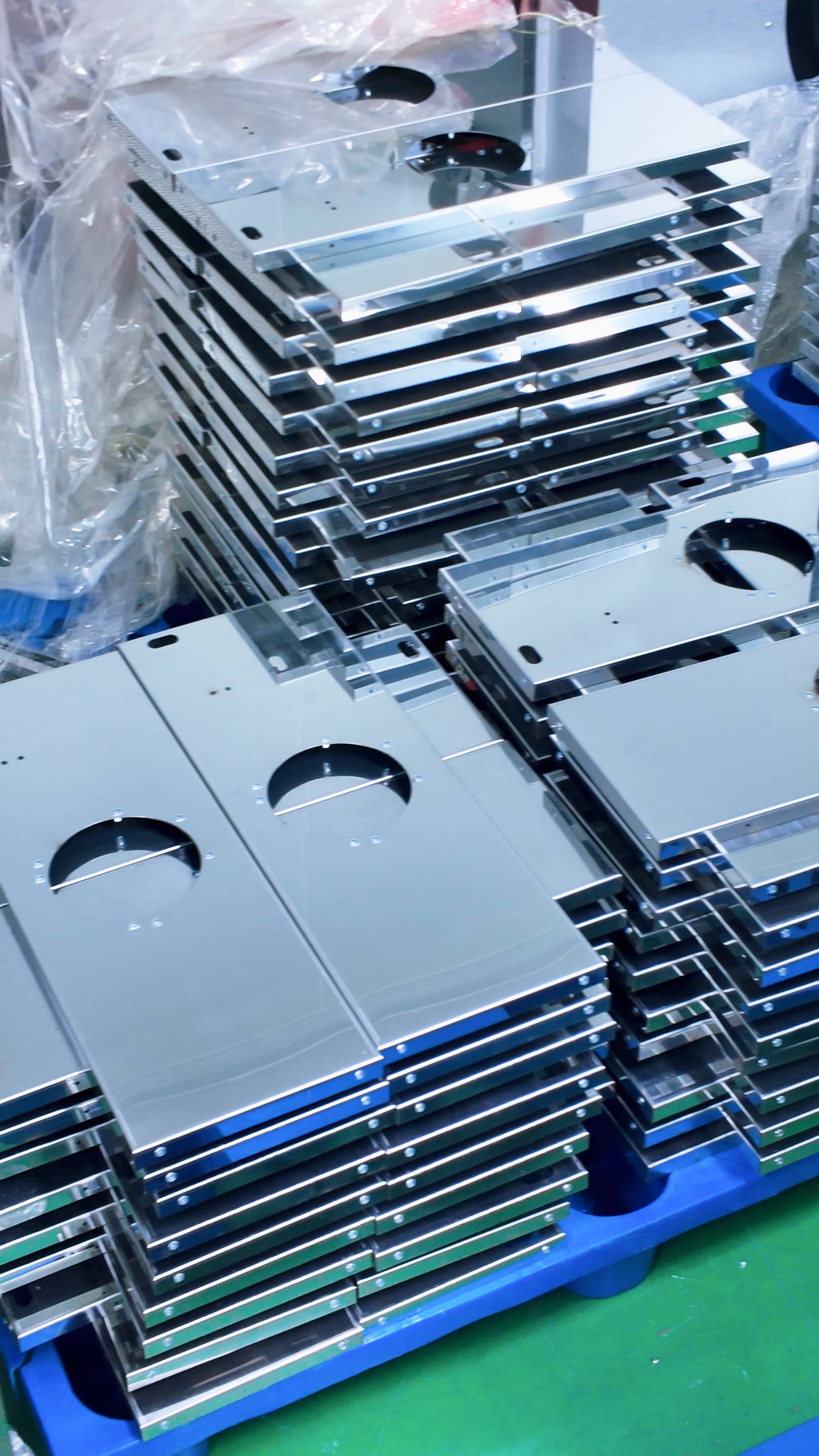
Materials that perform well in these settings share a few traits. Electropolished 316 stainless steel resists micro-scratches that would otherwise trap and later release debris. Dense epoxy or polyurethane coatings, when applied without pores, offer a non-porous barrier that doesn't flake under routine cleaning. For softer-touch zones, high-grade silicone or thermoplastic elastomers formulated for cleanroom use can provide grip without the shedding typical of foam or fabric-based covers. The key is to match the material to the exact stress pattern at each touchpoint: a button pushed hundreds of times a day needs a different solution than a rail that's only brushed in passing.
Selection should also account for how a surface will be cleaned. Aggressive disinfectants can degrade some polymers over time, creating new particle sources even if the material started out low-shedding. A useful approach is to test candidate materials under real usage cycles—wiping, rubbing, pressing—and measure particle release before committing. Replacing high-wear parts on a schedule, rather than waiting for visible wear, also helps keep every critical touchpoint from quietly becoming a contamination source.
Gowning Protocols Engineered to Reduce Human-Borne Contamination
Most contamination events in controlled environments trace back to how people enter the space, not the HVAC filters or cleaning chemistries. A gowning protocol built around human-borne risks starts with sequencing: hair cover first, then face mask, then boots, then coverall, then gloves—each layer applied so that the next doesn't shed onto the previous. The logic is simple but often skipped in practice. If you glove up before donning the hood, the glove's outer surface touches the hood's inner lining, carrying skin flakes and oils into the exact zone you're trying to protect.
The materials themselves matter less than the fit and the donning environment. A coverall with elastic cuffs and an integrated hood reduces gaps, but only if the wearer doesn't roll sleeves or leave the zipper partially open. Bench-level gowning areas benefit from sticky mats, mirror stations, and enough space to move without brushing against walls. More importantly, the protocol should be written as a set of negative checks: no exposed skin below the neck, no jewelry, no makeup, no phone. Those specific prohibitions do more to cut human-borne contamination than generic reminders to "be careful."
Retraining usually fails because it re-explains the same steps in the same order. A better approach is to audit gowning behavior without notice, then feed the findings back to each shift as a short list of observed deviations—not names, just patterns. When workers see that the main gap is people touching the outside of their face mask after gloving, they can adjust their own sequence. Over time, the protocol becomes less about compliance and more about a shared habit of keeping skin, hair, and respiratory droplets out of the product zone.
Continuous Particle Monitoring Without Alert Fatigue
Most continuous particle monitoring setups create a paradox: they're meant to safeguard cleanrooms, yet their constant shrill alerts train operators to ignore real signals. By treating every transient spike as an emergency, these systems bury meaningful deviations under routine noise. A better design starts with statistical baselines that learn each location's normal particle profile, including periodic events like door openings or equipment cycles.
Instead of fixed thresholds, adaptive monitoring compares live counts against expected variation. When a shower of particles appears but stays within historical bounds, the system stays quiet. Only when counts depart from the established pattern in a statistically significant way does it escalate. This filters out false positives from cleaning, material transfer, or sensor perturbations without requiring manual suppression.
The result is an alert stream that operators can actually trust. Because every notification points to a genuine anomaly, response times improve and investigation quality rises. Continuous data continues to flow for audits and trend analysis, but the human attention is reserved for true excursions. This balances regulatory visibility with operational calm.
Preventive Maintenance Routines That Stop Contamination at the Source
Most contamination events don't start with a dramatic failure—they begin with a slow leak, a saturated filter, or a drain line that hasn't been checked in months. Replacing air intake filters on a calendar schedule rather than waiting for a pressure drop alert keeps particulates out of pneumatic lines and process air. The same goes for liquid systems: swapping O-rings and shaft seals at the first sign of weeping prevents product contact surfaces from becoming a breeding ground.
Condensate management is another quiet culprit. Automatic drains on air receivers and dryers often stick open or closed without anyone noticing. A weekly manual blowdown plus a quarterly check of the drain solenoid takes less than ten minutes but eliminates a steady feed of moisture and oil into downstream piping. For hydraulic power units, sampling oil every 250 running hours and replacing breather filters whenever the reservoir level changes significantly catches abrasive wear particles before they circulate through valves and cylinders.
Lubrication points deserve a hard look, too. Over-greasing bearings pushes old, contaminated grease into housings where it hardens and attracts dust. Switching to metered, small-volume lubrication with a written visual check for purge color keeps the fresh grease doing its job without the side effect of trapping debris. These routines work because they target the root path—the point where foreign material first enters—rather than chasing the defects it causes later.
FAQ
The interaction between people and airflow tends to get less attention than filter specs. Even with the right HEPA coverage, a person reaching across a work surface can drag particles into a critical zone. Mapping actual movements and adjusting processes to keep hands and tools away from unidirectional air usually yields faster particle reductions than adding more filtration.
Higher air change rates are not automatically better. Once you pass the point where particle removal stabilizes for your process, every extra air change mainly adds fan energy and filter wear. A better approach is to measure recovery times after a disturbance and tune the rate to meet the worst real event, not a rule-of-thumb number.
People are the largest source of viable and non-viable particles in most cleanrooms. Garments that fit poorly or are donned incorrectly undo the work of expensive HVAC systems. Simple improvements such as changing gloves more frequently, selecting fabric based on actual particle shedding data, and training on proper gowning order often cut contamination events sharply.
It shifts the team from reacting to failed batches to catching excursions while they happen. Instead of waiting for a weekly report, operators can see spikes when a door opens too long or a cleaning step is missed. That immediate feedback builds better habits and makes root cause analysis much faster.
The most useful suppliers treat your process as the starting point. They will walk the cleanroom, look at transfer procedures, cleaning schedules, and operator flow, then suggest equipment that fits those needs rather than pushing a catalog. That consultative approach prevents costly mismatches like oversized pass-throughs or benches that disrupt laminar flow.
Smooth, non-shedding, and chemical-resistant materials work best, but the real test is cleanability. Stainless steel and certain coated panels are common because they tolerate repeated wiping with disinfectants without degrading. Avoid textured surfaces, exposed fasteners, and joints that trap residue, since those create hidden reservoirs for contamination.
Using the wrong wiping motion is surprisingly frequent. Wiping in circles or back-and-forth can redeposit particles instead of removing them. Trained teams use overlapping unidirectional strokes and fold wipes to present a fresh surface repeatedly. Another mistake is letting disinfectant dwell too short a time, which leaves viable organisms on surfaces that look clean.
Look at trend data rather than isolated particle counts. A stable cleanroom shows occasional spikes that return to baseline quickly, with no upward drift over time. If you see slow baseline creep, that points to a source such as filter bypass, worn garments, or a change in cleaning chemicals, and it is usually cheaper to investigate early than to wait for a product failure.
Conclusion
Achieving optimal contamination control starts well before any equipment is installed. Cleanroom equipment providers now emphasize that airflow patterns must do more than simply move air—they need to create pressure cascades and unidirectional streams that keep particles suspended and moving away from critical zones, rather than allowing them to drift onto work surfaces. This philosophy carries directly into filter selection. High-efficiency media are not one-size-fits-all; the right choice depends on the target ISO class, with ULPA filters reserved for the most stringent environments and HEPA variants specified according to particle challenge and energy costs. By matching filter performance to actual cleanroom classification, facilities avoid unnecessary pressure drop while still protecting product integrity.
Surfaces matter just as much as the air. Equipment companies are moving toward low-shedding polymers, electropolished stainless steel, and seamless coatings for everything from benches to pass-through chambers. These materials reduce particle generation at the very points where operators interact most. At the same time, gowning protocols are being redesigned around human factors—fewer complex steps, clearer donning sequences, and integrated disposable components that minimize skin and fiber release. Continuous particle monitoring has shifted away from alarm-heavy systems that desensitize staff; instead, smart thresholds and trend analysis flag only meaningful deviations. Finally, preventive maintenance is no longer just about changing filters on a calendar. Vibration checks, gasket integrity tests, and airflow velocity verification are scheduled based on real usage data, stopping contamination at its source before it ever reaches the cleanroom floor.
Contact Us
Contact Person: Amy Yang
Email: [email protected]
Tel/WhatsApp: 008619330882686
Website: https://www.genopharmatech.com/