

China Tubular Steel Towers Factory for Reliable Power Transmission Infrastructure
2026-08-16
When it comes to power transmission infrastructure, the backbone often goes unnoticed—yet it carries the weight of entire regions. Among the many manufacturers in China, Anbang tubular steel towers stand out not just for their structural integrity, but for a quieter kind of reliability: one that has been tested by years of demanding grid projects across varied terrains. In this post, we look beyond the standard specs to explore how Anbang’s approach to design, material selection, and on-site adaptability is reshaping what utilities should expect from a factory partner.
Inside the Production Line: How Steel Coil Becomes a Galvanized Transmission Tower
The journey starts with raw steel coil, often several tons of tightly wound strip. Uncoiled and flattened, the steel moves into a slitting line where rotary knives slice it into narrower bands matched to the specific angle and plate sizes a tower design demands. These bands are then cut to length, and a punch press or laser cutter pierces bolt holes and notches with tight tolerances. Scrap is minimal because nesting software arranges the parts like puzzle pieces across the strip, and the leftover skeleton is baled for recycling.
From there, the flat blanks enter a press brake or roll former. Operators bend the steel into angles, channels, and Z-sections that will become legs, bracing, and gusset plates. Each bend is checked against a master drawing, often with a quick gauge or a digital protractor. Batch numbers are stamped into every piece so that later, if a bolt hole doesn't line up, the shift and coil heat can be traced within minutes. The formed parts are stacked on racks and moved to the galvanizing bay.
Galvanizing is where the tower gains its weatherproof skin. Parts are hung on jigs, then dipped through a sequence of tanks: degreasing, rinsing, acid pickling, another rinse, and a flux bath. Finally, the steel is submerged in molten zinc at around 450°C. The zinc metallurgically bonds to the surface, forming layers of iron-zinc alloy that are far tougher than paint. Once withdrawn and cooled, the coating thickness is spot-checked with a magnetic gauge. The finished members—silvery and slightly textured—are bundled by tower section and shipped to the site, ready to be bolted together into a structure that will stand for decades.
Tapered Tubular Sections: Engineering Towers for Wind, Ice, and Uneven Terrain
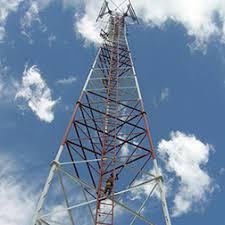
Tapered tubular sections have become a quiet workhorse in tower design, not because they shout for attention but because they solve real-world loading puzzles with an economy of material that few other shapes can match. When a tower must stand against gusts that push and pull from every direction, the gradual reduction in diameter from base to tip reduces both the projected area exposed to wind and the mass that the lower structure has to carry. This is not merely a geometric convenience; it is a strategy for survival in places where wind speeds vary dramatically with height. The result is a form that feels almost natural, as if the tower grows out of the terrain rather than being imposed upon it.
Ice loading presents a different kind of threat, one that accumulates silently and can transform a slender mast into a brittle, top-heavy column. A tapered section, with its larger cross-section near the foundation, places more material where the bending moment from ice and wind combined is greatest. This is not a one-size-fits-all fix; designers must account for glaze ice versus rime ice, for the way ice sheds unevenly, and for the sudden dynamic snap when a large chunk breaks free. The tapered profile helps manage these unpredictable loads by reducing the moment arm of the ice mass near the top and by providing a stiffer lower section that resists the torsional and lateral forces better than a constant-diameter tube of similar weight.
Uneven terrain forces engineers to think beyond the tower itself. On a slope, the wind flow is no longer horizontal but follows the contours of the ground, creating zones of acceleration and turbulence that can fatigue a structure in ways a flat-site tower never experiences. A tapered tubular section helps here by shifting the fundamental frequency slightly upward compared to an equivalent straight tube, which can be tuned to avoid the dominant gust frequencies of a particular site. The larger base also offers a more forgiving foundation interface, allowing for minor adjustments in anchor positioning without compromising the overall stability. It is a subtle shift in perspective: the taper is not just about reducing steel, but about aligning the structure with the messy, uneven world it must inhabit.
Quality Gates from Raw Material to Trial Assembly: What Buyers Should Verify
Raw material inspection sets the tone for the entire production run. Buyers should request mill certificates for steel, aluminum, or polymer batches, then cross-check heat numbers and chemical composition against the order spec. A quick on-site hardness test or spectrometer scan catches substitutions that might otherwise slip through. For surface-critical parts, ask to see the actual incoming sheets or bars under shop lighting, not just a sample cut from the end.
Before any trial assembly, verify the first-off parts against a controlled drawing set. Measure key dimensions with the supplier's own instruments, then repeat with your calibrated tools to expose any gauge bias. Check thread fit, hole alignment, and weld penetration at this stage, not after fifty units are built. Pay attention to how the factory handles non-conforming pieces: if they are set aside with a clear tag and routed to a designated quarantine area, that signals a functioning quality loop. If they are quietly reworked on the spot, dig deeper.
Finally, watch the trial assembly itself. Ask the line leader to build one unit without any special preparation, using parts pulled randomly from the bin. Note every time a worker has to file, shim, or force a fit. Those moments reveal tolerance stacking or fixture drift that a polished sample will hide. A good supplier will log every adjustment and propose a corrective action before moving to the next station, not promise to fix it during mass production.
Hot-Dip Galvanizing and Coating Consistency: What Separates a Standard Finish from a Long-Life Tower
The difference between a standard galvanized finish and one that lasts decades usually comes down to two things: zinc thickness and how evenly that zinc bonds across every weld, edge, and bolt hole. On most communication or transmission towers, the hot-dip process itself doesn't vary much—it's the control of steel preparation, bath temperature, and withdrawal speed that separates a uniform, abrasion-resistant layer from one that thins prematurely at corners or traps flux under heavy mill scale.
Coating consistency also depends on the metallurgical makeup of the zinc bath. Small additions of aluminum, nickel, or bismuth change the fluidity and grain structure of the coating, influencing how well it adheres to the steel and how it behaves when the tower is erected and exposed to years of wet-dry cycling. A standard finish might meet a single thickness reading in the middle of a flat plate; a long-life tower meets the same minimum on its sharpest angle and inside its most complex connection detail.
That kind of consistency is rarely visible to the naked eye on day one. It shows up later, as the difference between a tower that develops rust blooms around its base plates and guy attachments after ten years and one that keeps its bond intact through decades of temperature swings and industrial or coastal air. For owners who plan on 50-year service life, the extra attention to bath chemistry, post-galvanizing inspection, and repair of inevitable handling damage is not a cosmetic upgrade—it's the true cost of avoiding early structural corrosion.
Moving Oversized Tower Segments: Port Handling, Route Surveys, and On-Site Assembly Prep
Port handling for oversized tower segments begins well before the vessel arrives. The dock team coordinates with heavy-lift crane operators to establish lift plans that account for each segment’s center of gravity, rigging angles, and wind limits. Self-propelled modular transporters (SPMTs) are staged near the quay, their hydraulic suspensions adjusted to distribute weight evenly across dozens of axle lines. Once a segment is offloaded, it gets lashed to saddles or bolsters with chain binders and load-rated straps, then moved to a temporary laydown area with enough room for later transfer without double handling.
Route surveys turn a seemingly straightforward road move into a step-by-step clearance exercise. Survey crews measure overhead utility lines, bridge load ratings, turning radii at intersections, and even the camber of pavement on curves. In many cases, temporary ramps or steel plates are laid over weak spots, and traffic signals or sign structures get temporarily swung aside. Escort vehicles with height poles run ahead to confirm clearances in real time, while local authorities coordinate rolling roadblocks so the convoy never has to stop on a steep grade or narrow shoulder.
On-site assembly prep begins with verifying that the foundation anchor bolts and embedment plates match the segment’s flange pattern before any crane work starts. A dedicated staging zone is set up within the crane’s working radius, often with compacted gravel or crane mats to handle the ground bearing pressure from both the crane and the segment. Surveyors then establish control points on the foundation and on the segment itself, using total stations or laser trackers, so that the initial lift can be guided into place without repeated bumping. Crews pre-install alignment pins, jacking brackets, and temporary guide rails, cutting the time the segment spends suspended in the air.
Custom Tower Configurations for Substation Gantries, Dead-Ends, and River Crossings
Substation gantries rarely work well with standard lattice tower drawings. The required phase spacing, bus heights, and insulator swing clearances shift too much from one yard to the next. Custom configurations often shorten the top crossarm, add a fourth conductor level, or offset the tower body to avoid an existing control building. Short-circuit forces push the conductor hard in one direction while wind loads push in another, so the bracing pattern in the upper bay is reinforced and the splice plates are detailed for quick field alignment.
Dead-end configurations are not just about heavier steel. The longitudinal pull from conductors on one side creates a torsional twist that standard tangent towers never experience. Custom designs for dead-ends often extend the inner longitudinal arms, stiffen the hip joints, and shift the leg batter to reduce uplift on the back side. Some sites require a guyed mast instead of a full four-legged tower because the right-of-way is too narrow for wide foundations.
River crossing towers have to serve two masters: navigation clearance below and conductor clearance above. Custom configurations here frequently raise the base of the conductor attachment point well above flood stage, with longer insulator assemblies to handle salt or industrial pollution near the water. Lateral vibration from steady winds across open water is another driver, so designers increase the spacing between phase positions and add interphase spacers or Stockbridge dampers. In places where ice buildup is expected, the tower top is braced with redundant diagonals to survive a sudden conductor gallop without cascading failure.
FAQ
We mainly manufacture suspension, tension, and angle towers for transmission lines ranging from 10kV to 500kV. The tubular design can be either conical or polygonal, and we also handle communication and substation structures if the project calls for them.
Every design goes through finite element analysis before production, and we test full-scale prototypes under simulated wind, ice, and seismic loads. The steel grade and weld procedures are selected based on the specific climate zone of the installation site, not just a generic standard.
Yes, customization is a core part of what we do. We work from your load calculations and line survey data to adjust leg slopes, cross-arm lengths, and base plate dimensions. For mountainous or swampy terrain, we can also modify the tower body geometry to reduce foundation costs.
We typically use Q355B or Q420B high-strength steel, depending on the structural requirements. For corrosion protection, hot-dip galvanizing to ASTM A123 or ISO 1461 is standard, and we can add a duplex coating of zinc plus epoxy paint for coastal or industrial areas with high salinity.
For a standard order of 500 to 1,000 tons, production usually takes 30 to 45 days after final drawing approval. If the design is complex or we need to source special steel grades, it can extend to 60 days, but we always confirm a realistic schedule before signing the contract.
We pack the tower members in bundles with steel strapping and mark each piece with a unique part number that matches the assembly drawing. For export, we use waterproof wrapping and load containers or breakbulk vessels based on the size of the order, and we provide a detailed packing list for customs clearance.
We include a complete assembly manual and torque specifications with every shipment. If the project demands, we can send a supervisor or a small technical team to the site for the first few towers to ensure the erection process goes smoothly, though this is usually arranged separately.
Our factory holds ISO 9001 for quality management and ISO 3834 for welding. We also perform ultrasonic and magnetic particle inspection on critical welds, and each batch of steel is traceable back to the mill certificate. Before dispatch, we do a trial assembly of at least one complete tower section to check fit-up.
Conclusion
A dependable tubular steel tower begins long before it reaches the transmission line. Inside a Chinese factory focused on power infrastructure, the journey starts with raw steel coil, which is cut, bent, and welded into tapered sections engineered to handle wind shear, ice loading, and uneven terrain. Quality gates are embedded at every stage—from material certification and dimensional checks to full trial assembly—so buyers can verify that each tower meets the exact loading requirements of its site. Hot-dip galvanizing is not an afterthought; coating thickness, uniformity, and adhesion are tested to distinguish a standard finish from one that will resist corrosion for decades in harsh environments.
Beyond the production floor, logistics and customization make the difference for complex projects. Oversized tower segments require careful port handling, route surveys, and pre-assembly preparation to avoid delays at remote sites. The same factory can adapt its standard production line to deliver substation gantries, dead-end structures, and river crossing towers, each with unique base geometry and connection details. This combination of disciplined manufacturing, verified corrosion protection, and flexible design support is what positions a China tubular steel towers factory as a reliable partner for power transmission infrastructure that must perform under real-world stress.
Contact Us
Contact Person: antor khan
Email: [email protected]
Tel/WhatsApp: 8613863903569
Website: https://www.qdabtower.com/