

China Stainless Steel Lag Bolt A Definitive Guide for Builders and DIYers
2026-10-28
Rusted lag bolts have killed more outdoor projects than bad weather. If you're tired of snapping heads and corroded threads, it's time to look closer at where your fasteners come from—and what they're made of. China's stainless steel lag bolt industry has quietly raised the bar, and manufacturers like Wanluo are leading the charge with alloys that shrug off salt spray and torque without complaint. This guide cuts through the spec-sheet noise to give builders and DIYers exactly what they need: how to pick the right bolt, avoid counterfeit stainless, and work with suppliers who actually test what they ship. Let's get into the details that hold everything together.
What Separates Quality Chinese Stainless Lag Bolts from the Rest
A lot of importers stop at “stainless steel” without checking the actual grade. Quality Chinese stainless lag bolts start with controlled alloy composition—typically 304 or 316—where nickel and chromium percentages are verified on each heat, not just promised on a spec sheet. Lower-grade batches often use recycled scrap with uncontrolled trace elements, which shows up later as pitting or weak threads.
The thread-forming step separates the good from the mediocre. Precision-rolled threads, rather than cut threads, leave a denser surface and better fatigue resistance. In reliable factories, the rolling dies are replaced on a strict schedule, and the shank is kept straight within tight tolerances. Cheap bolts often have slightly oversize or undersize pitch diameters, so they either bind in hardwood or strip out under torque.
After forming, passivation matters more than most buyers realize. A proper nitric or citric acid passivation removes free iron from the surface and builds a uniform oxide layer—without it, even 316 stainless can rust at contact points. The best suppliers also do batch testing for torque-to-failure and salt spray hours, not just visual checks. That’s why their lag bolts hold up in coastal decks and outdoor timber structures where others fail within a year.
Grades and Finishes That Hold Up in Wet Conditions
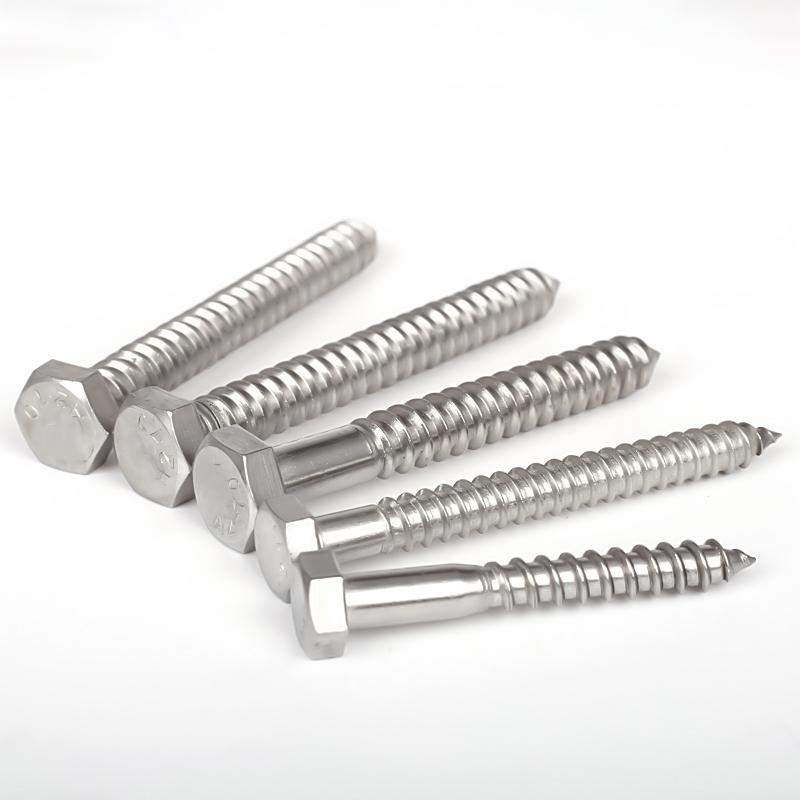
When moisture is a constant presence, material choice narrows quickly. 316 stainless steel is the usual go-to because its molybdenum content helps resist pitting and crevice corrosion, but it is not the only option. Duplex grades like 2205 bring higher strength and better chloride tolerance, which matters in coastal or industrial washdown areas. Even within a grade, surface finish changes behavior: a rough, as-welded surface traps water and contaminants, while a smooth, electropolished finish reduces adhesion and makes routine cleaning far less of a chore.
Coatings can extend life, but only if they bond well and stay intact. Thin-film ceramic or epoxy coatings work for some brackets and housings, yet scratches or edge wear quickly expose the base metal. For fasteners and fittings, a combination of a corrosion-resistant alloy and a passivated surface often outperforms a coated carbon steel part. Passivation removes free iron and encourages a thicker chromium oxide layer, which is what actually keeps rust from starting.
Texture also plays a role. A brushed or matte finish hides water spots and minor staining better than a mirror polish, but it may hold more moisture in the microscopic grooves. In splash zones or areas that stay wet for hours, a vertical or angled surface with a directional grain can shed water more effectively. The best choice usually pairs a proven grade with a finish that matches the actual exposure, not just the spec sheet.
Reading a Supplier Spec Sheet Without Getting Lost
Most spec sheets are organized to make the supplier look good, not to help you find the number that breaks your design. The first move is to ignore the bold headline specs and go straight to the test conditions and footnotes. A 5 A rating at 25°C can become 2.8 A at 70°C once you read the derating curve tucked three pages later. If a value only appears as a typical with no minimum or maximum, treat it as a suggestion, not a guarantee.
Read the document backward. Start with the revision history and ordering codes, then move to electrical characteristics, and only then glance at the marketing summary on page one. This keeps you from anchoring to the first impressive number and missing a silent change between revisions. While you're at it, mark every asterisk and superscript. Those tiny notes often carry the real constraints: specific test loads, pulse widths, or supply voltages that may not match your application.
Before you close the sheet, run a quick checklist against your own circuit: operating temperature range, input voltage tolerance, output load limits, timing or logic thresholds, and any flag like not recommended for new designs. Skipping any of these is usually what turns a clean prototype into a costly re-spin. If the sheet leaves a critical parameter vague, call the supplier or find a second source, never fill that gap with optimism.
A Builder’s Checklist for Lag Bolt Sizing and Pilot Holes
Lag bolts, or lag screws as they're often called on the jobsite, are the backbone of heavy timber connections. Yet too many builders treat sizing as a guess-and-go affair. The real trick is matching the bolt's diameter to the load path, not just the board thickness. For a 2x ledger carrying deck joists, a 1/2-inch lag is typical, but bump that to 5/8-inch if you're cantilevering or dealing with wet-service lumber. Length matters just as much: you want at least two-thirds of the bolt buried in the receiving member, with the unthreaded shank spanning the shear plane.
Pilot holes are where most failures start. Drilling them too small invites splitting, especially near board ends or in dense hardwoods like oak. A good rule of thumb: the pilot for the threaded portion should match the shank diameter minus the thread depth—roughly 60 to 75 percent of the nominal bolt size, depending on wood species. For the unthreaded shank, use a bit equal to the bolt diameter so the top piece pulls tight without jacking. Softwoods like SPF forgive slightly smaller pilots; hardwoods demand the upper end of that range and a countersink for the head.
Don't skip the wax or soap on the threads, and back out any bolt that starts to squeal before seating. If you're working near the edge, keep the pilot centered—no closer than four times the bolt diameter from the end grain. For multiple lags in a row, stagger them slightly rather than running a straight line that can split the member. And when in doubt, test on a scrap cutoff from the same lift: if the wood cracks before the head seats, step your pilot bit up by 1/64 inch and try again.
Outdoor Projects Where Cheap Fasteners Fail First
Decks are the classic early warning system. Ledger boards and joist hangers take constant shear and uplift, and a bargain zinc screw will start to rust at the thread roots within the first wet season. Once that happens, the metal loses its bite, boards begin to squeak, and a railing post that felt solid in June can wobble by October. You will notice the failure at the connection points long before the wood itself shows any wear.
Fence gates and hinged panels are next. A gate concentrates its entire weight plus the force of every open and close onto two or three hinge screws. Cheap fasteners here either snap under the repeated load or slowly wallow out their holes until the gate drags. On windy sites, the same cheap nails used for pickets will back out, leaving the fence looking tired and forcing you to re-set every board after a storm.
Raised beds and outdoor furniture round out the list. Constant soil moisture, fertilizer salts, and direct ground contact eat through thin electroplating in a single growing season. The first sign is often a dark stain bleeding from the screw head, followed by a loose corner joint or a wobbly bench leg. Here, the fastener fails quietly, and by the time you notice, the surrounding wood is already damaged and needs more than a replacement screw.
How to Spot Red Flags Before You Place a Bulk Order
A low price can be tempting, but when a bulk order quote comes in significantly below every other supplier, treat that gap as a warning rather than a bargain. Legitimate manufacturers rarely undercut the market by huge margins without cutting corners on materials, labor, or compliance. Before you commit, ask for a detailed cost breakdown and check whether the unit price still holds after you specify your exact packaging, labeling, and quality requirements. If a supplier refuses to explain the pricing or keeps changing the terms after you ask basic questions, walk away.
Pay attention to how the vendor communicates during the negotiation stage. Slow or evasive replies, unanswered technical questions, and sudden changes in the point of contact often signal disorganization or a middleman hiding the real factory. Request a live video tour of the production line and ask to see samples that match the batch you will actually receive, not just a pre-made showroom piece. If the vendor pressures you to pay a deposit before you have signed a clear contract with material specs, defect tolerances, and shipment deadlines, that urgency is a classic red flag.
Finally, verify the company’s business history and certifications through independent channels. A genuine supplier should willingly provide a business license, export records, and third-party audit reports. Search for client feedback outside of the vendor’s own website, and be cautious if every review is suspiciously glowing or if there are no verifiable references for orders of your size. Small inconsistencies, like a registered company name that doesn’t match the bank account or an address that turns out to be a virtual office, often surface only when you dig a little deeper before placing the order.
FAQ
Many Chinese mills now produce A2 and A4 equivalents that hold up well in salt spray testing, but the key is requesting mill test reports and checking for passivation. A 316 stainless lag bolt with proper passivation will resist pitting far longer than a standard 304 fastener, and Chinese suppliers can offer both at competitive prices if you know what to ask for.
Start with a magnet test—304 and 316 are usually weakly magnetic after cold forming, but a strong pull suggests a ferritic or coated steel. Then check the head markings: reputable Chinese factories stamp A2 or A4 along with their own identification. Request a chemical composition certificate and, if possible, do a quick spark test on a disposable piece; stainless throws very few, short sparks.
For a typical deck ledger, 1/2-inch diameter by 4-inch length is the minimum, but if you are going through sheathing and into the rim joist, move up to 5/8-inch by 5-inch. Always ensure at least 3 inches of thread bites into solid framing, and pre-drill with a bit about 1/32-inch smaller than the shank to prevent splitting.
Yes, the biggest one is driving them too fast with an impact wrench. Stainless galling is real—if the threads heat up and bind, the bolt can twist off before it seats. Use a steady low-speed drill with a torque setting around 70-80% of the rated value, and lubricate the threads lightly with anti-seize or even paraffin wax.
Modern copper-based treatments like ACQ or CA are corrosive to ordinary steel, but 304 and 316 stainless are generally resistant. However, isolated stainless in wet treated wood can still suffer crevice corrosion. A simple barrier like a plastic washer or a dab of sealant under the head goes a long way, especially in ground-contact applications.
Lag originally meant the bolt was a lag screw—a heavy wood screw with a hex head—so there is no nut; the threads cut into the wood. That means you must pre-drill a pilot hole for the shank and a smaller pilot for the threaded section. Skipping the pilot hole is the fastest way to split a 2x or snap the head off.
Thread consistency varies more across Chinese suppliers, but top-tier factories use rolled threads rather than cut threads, which gives a smoother finish and higher fatigue strength. Ask for samples before placing a bulk order, and check the thread crests under a magnifier—rolled threads will look slightly rounded, while cut threads have sharp, jagged edges.
Not for standard 304 or 316 fasteners in atmospheric exposure. Hydrogen embrittlement is a concern mainly for high-strength martensitic stainless or electroplated carbon steel. If you are buying A4-80 or stronger bolts, ask about baking after plating, but for typical wood-to-wood connections under 80 ksi tensile, it is rarely an issue.
Conclusion
Builders and DIYers often assume that any stainless steel lag bolt out of China is basically the same, but after years of pulling corroded fasteners out of decks and docks, the differences become painfully clear. Quality Chinese stainless lag bolts start with proper alloying and clean thread rolling; cheaper options may use recycled scrap with inconsistent nickel and chromium content, which weakens both tensile strength and corrosion resistance. For wet or coastal environments, you really want 316 grade over 304, and a passivated finish that removes free iron from the surface—otherwise you will watch rust bloom within the first season. A dependable supplier provides a clear spec sheet showing not just the grade but also the exact ASTM or ISO standard, the thread class, and the coating or treatment applied.
Reading that spec sheet does not require an engineering degree; focus on the three or four numbers that matter for your load and exposure. Sizing is just as critical: the pilot hole diameter and embedment depth determine whether the bolt holds or splits the wood. Outdoor projects like pergolas, docks, and retaining walls are where cheap fasteners fail first—often within months—because they cannot handle the combination of moisture, temperature swings, and shear forces. Before placing a bulk order, watch for vague phrases like “stainless steel” without a grade, missing mill certificates, or prices that seem too low to cover real 316 alloy. Ask for a sample, cut one open if you can, and check the threads under magnification. A little caution on the front end saves a lot of tear-out and replacement later.
Contact Us
Contact Person: Shane
Email: [email protected]
Tel/WhatsApp: 8613357785029
Website: https://www.wanluohardware.com