

Boron Carbide Powder Factory: Inside Advanced Materials Production
2026-10-30
Peek behind the gates of a boron carbide powder factory and you won't find magic—just a brutal obsession with particle size, purity, and repeatability. At HUAYI TECH, that obsession is on display from raw boron/carbon blending to final classification. This post takes you inside the production flow, showing how advanced materials like boron carbide go from furnace to finished powder, and why the unglamorous steps often decide whether a batch meets armor-grade specs or gets rejected.
Inside the Furnace: Where Boron and Carbon Fuse
Inside the furnace, boric oxide and petroleum coke don't simply mix—they undergo a violent rearrangement once the arcs strike and the temperature climbs past 2,000°C. Boron atoms rip free from oxygen, latch onto carbon, and shed carbon monoxide in thick, pale plumes. The melt churns under a crust of unreacted charge, and every few minutes operators probe the bath or skim the surface to keep the chemistry from drifting.
The hardest part isn't reaching the heat; it's holding the right boron-to-carbon balance. Too much carbon leaves graphite flakes scattered through the ingot. Too little leaves boron-rich phases that crumble when machined. Skilled furnace crews read the arc color and the smoke's tint, making small feedstock adjustments long before a lab report lands. The cooling stage matters just as much—fast quenching locks in fine grains, while slow cooling grows crystals that can tear a grinding wheel apart.
What solidifies is boron carbide: a black, nearly diamond-hard ceramic that shrugs off abrasive wear and stops high-velocity projectiles. It emerges rough and oversized, later crushed, milled, and shaped into plates, nozzles, and grit. The furnace doesn't just combine two elements; it forces them into a lattice so stubbornly bonded that only a diamond scratches it with ease.
Grinding, Classifying, and the Pursuit of Uniform Particles
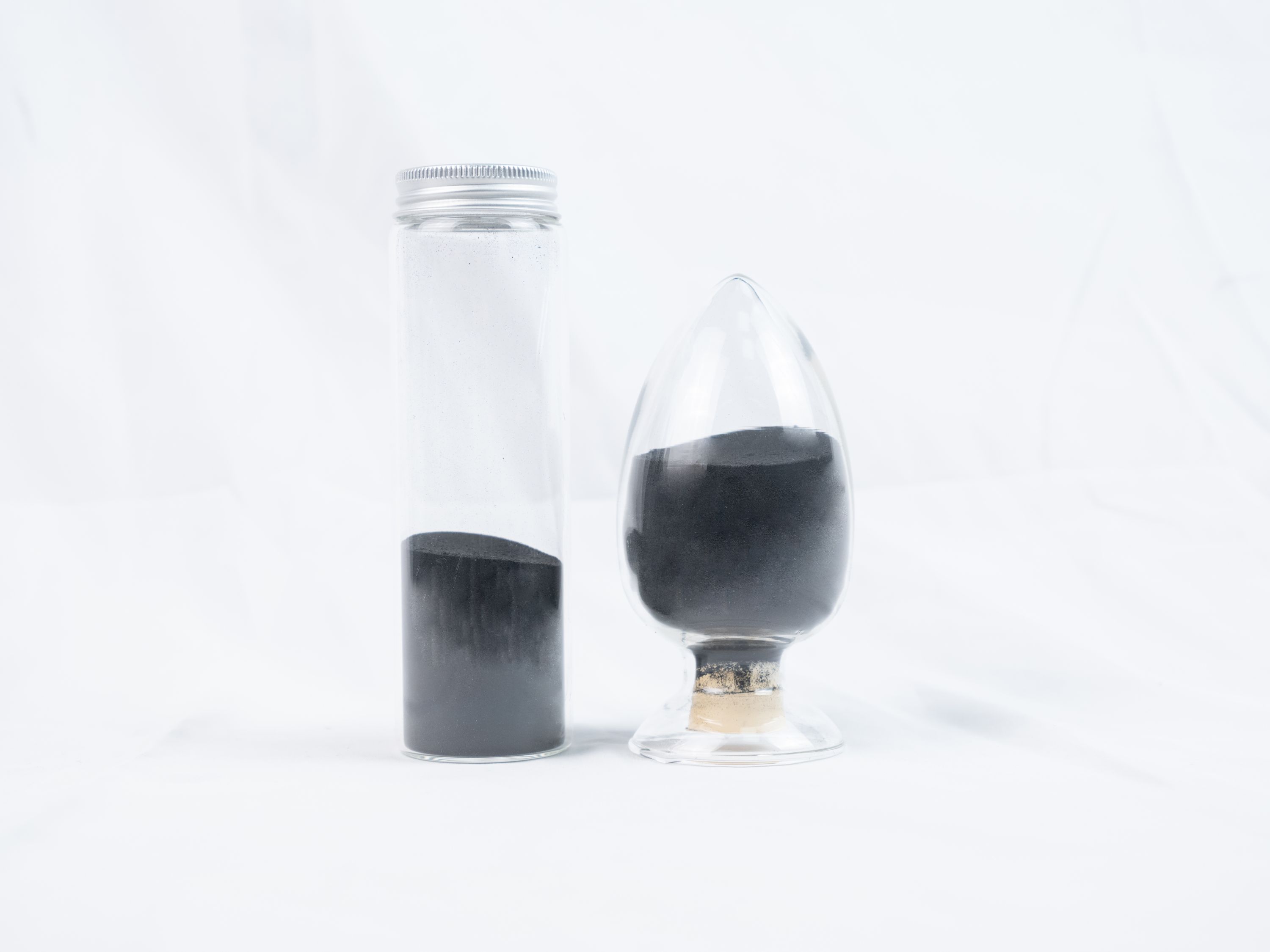
The journey toward uniform particles rarely begins with a single dramatic step. It starts with grinding—an aggressive, often chaotic process where raw chunks are broken down under mechanical stress. But grinding alone doesn't guarantee consistency. Depending on feed rate, moisture, and the mill's internal geometry, you can end up with a wild spread of sizes that looks uniform at a glance but fails the moment someone runs a particle size analysis. Smart operators treat grinding as a controlled fracture event, not just brute force.
That's where classifying enters the picture. Instead of hoping the mill produces exactly the right size, a classifier sorts the output, sending oversized particles back for another pass and allowing only the acceptable range to move forward. The result is a closed-loop system that trades raw throughput for remarkable precision. The subtlety lies in where and how the cut point is set—too tight, and you waste energy and time; too loose, and the downstream product loses the very uniformity you set out to achieve.
Pursuing uniform particles, then, is less about finding one perfect machine and more about balancing fracture, separation, and recirculation. Each material has its own breaking behavior, and each application has its own tolerance for variation. The real craft is in watching how a powder behaves after each change: slightly narrower classifier settings, a different grinding media size, or a few percentage points of moisture can shift the distribution in ways that a datasheet never predicts. Uniformity isn't a switch you flip; it's a condition you tune toward, measurement by measurement.
Why Particle Size Dictates Ceramic Armor Performance
The microstructure of ceramic armor is not a random arrangement but a deliberate stacking of grains, and the average particle size acts as the primary switch for how energy is absorbed during impact. Finer particles, typically below one micron, force a projectile to split and deflect repeatedly at grain boundaries, which multiplies the number of micro-cracks before a catastrophic failure can propagate. Coarser grains, on the other hand, allow a crack to run longer distances with less resistance, trading hardness for a slight gain in fracture toughness. The real trick is that each grain boundary becomes a barrier: the smaller the grain, the more barriers per unit volume, and the more fragmented the incoming threat becomes before it can reach the backing plate.
When a bullet strikes, the ceramic does not simply shatter—it converts kinetic energy into surface energy through an intricate web of intergranular fractures. Small grains create a dense network of weak interfaces that absorb energy stepwise, whereas large grains fail in a more brittle, brittle-by-design manner. This explains why a fine-grained alumina tile outperforms a coarse one of identical chemistry and thickness: the same material, same density, but the size of its building blocks dictates whether the impact becomes a localized crater or a controlled, widespread dislocation of the armor's surface. The optimal size is never arbitrarily small, though, because beyond a certain limit, sintering becomes difficult and internal porosity undermines the very barrier effect the grains were meant to provide.
In practice, armor designers tune particle size to the specific threat. Against high-velocity armor-piercing rounds, sub-micron grains are favored because they maximize hardness and delay the onset of radial cracking. Against heavier, slower projectiles, a slightly coarser distribution may be chosen to avoid excessive fragmentation that could allow the ceramic to be pushed aside rather than resist. No single grain size wins every scenario, but the common thread is that particle size is the silent dictator: it sets the length scale for failure, the density of energy sinks, and ultimately the threshold at which a ceramic plate turns from protective shield into shattered debris.
Quality Checks That Catch Subsurface Contaminants
Handheld photoionization detectors and flame ionization detectors give instant readings in soil gas and headspace samples, but they only flag volatile compounds above a threshold. Pairing that with colorimetric tubes for specific chemicals like benzene or hydrogen sulfide can narrow down what is actually moving beneath a slab. Low-flow groundwater sampling keeps turbidity low so dissolved-phase metals and chlorinated solvents don't get artificially elevated or missed.
The lab side matters just as much. Trip blanks and equipment blanks track contamination introduced during transport or handling, while field duplicates show whether the sampling method is repeatable. For volatiles, methanol preservation and zero-headspace vials prevent losses that would otherwise make a plume look smaller than it really is. Setting reporting limits below vapor intrusion screening levels is the only way to catch low concentrations of trichloroethylene or tetrachloroethylene before they become an indoor air problem.
Finally, a careful review of the data often uncovers what a single round of sampling can miss. Plotting results over time, checking ion balances, and comparing upgradient and downgradient wells help separate lab noise from a real release. If a result seems too clean next to a known solvent source, resampling with a different method or adding passive samplers can reveal contamination that standard grab samples overlooked.
Tailoring Powder for Nuclear and Aerospace Applications
For nuclear fuel cladding and control rod materials, powder specifications center on isotope enrichment and trace impurity limits. Zirconium alloy powders need oxygen below 1200 ppm and a narrow tin-niobium window to avoid hydride reorientation during service. Boron carbide powders for control rods require boron-10 enrichment above natural abundance while keeping free carbon and boron oxide low enough to suppress helium release under neutron flux.
Aerospace alloys like IN718 and CM247LC demand tight particle size distributions, often 15 to 45 microns for laser powder bed fusion, with satellite particle fractions below five percent to maintain consistent recoating. Coarser 53 to 150 micron powders used in directed energy deposition rely on high sphericity for stable feed rates, and adjustments in gamma prime formers such as aluminum, titanium, and tantalum shift creep resistance without sacrificing weldability.
Batch-to-batch repeatability remains the shared hurdle. Plasma rotating electrode processing produces the lowest oxygen and fewest hollow particles but at higher cost; gas atomization must balance nozzle geometry against satellite formation. Nuclear grades often undergo hydride-dehydride processing to refine grain size and avoid hot cracking in welded joints, while aerospace suppliers validate each lot through thermal analysis and microscopy before release.
From Raw Ore to Sealed Drum: A Walk Through the Plant
Ore comes off the haul truck still smelling of the pit—dusty, broken, and irregular. It gets dumped straight into the jaw crusher, where the first reduction happens in about the time it takes to check a clipboard. The crushed rock then rides a belt through a scalping screen; anything too big gets cycled back, while the rest moves on. Operators here watch the feed rate and the moisture more than any dashboard, because a clogged chute will tell you more than a sensor ever will.
The sized material then hits the concentrating circuit. This isn’t a one-size-fits-all step: the plant switches between flotation, gravity, and leaching depending on what the ore body gave us that month. Reagents are added in small, measured doses, and the slurry is thickened and filtered into a cake that’s heavy, dark, and only slightly damp. By the time it leaves this section, most of the waste rock has already been stripped away.
Packing is where the process gets physical again. The concentrate is conveyed into a sealed filling bay, where drums are tared, filled to a set weight, and capped under negative air pressure. A worker checks the seal by hand, slaps on a batch label, and sends the drum down a short roller track. Each sealed drum carries a lot number that links it back to the exact day and feed pile it came from—no exceptions.
FAQ
Its hardness ranks just below diamond and cubic boron nitride, but it’s far lighter, which is a rare combination. That lets factories produce armor plates, nozzles, and cutting tools that resist wear without adding excessive weight.
We rely on jet milling and air classification rather than a single grinding pass. Incoming feedstock is crushed, then repeatedly classified until the distribution fits a tight band. Laser diffraction checks every batch, and anything outside spec gets reprocessed.
Typically boric acid or boron oxide reacts with petroleum coke or carbon black in an electric arc furnace. The choice of carbon source affects impurity levels, so we source low-ash coke and adjust the stoichiometry to minimize free carbon and boron oxide residue.
Boron carbide forms through a carbothermic reduction that only completes above roughly 2,000°C. If the furnace runs too cool, you get unreacted boron oxide and carbon; too hot, and grain growth makes the powder harder to mill. We keep a narrow thermal window and monitor it with optical pyrometers.
Beyond armor ceramics, it’s used in abrasive water jet nozzles, nuclear reactor shielding because boron absorbs neutrons, and as a sintering aid or additive in refractory linings. Some customers also use fine grades for lapping and polishing hard materials.
Boron carbide dust is abrasive but not acutely toxic; however, we treat all fine powders as respiratory hazards. The production area runs under negative pressure with HEPA filtration, workers wear powered air-purifying respirators during packaging, and vacuum systems are grounded to prevent dust explosions from carbon byproducts.
Yes, surface area, particle shape, and impurity profile can be tuned. Some clients want a narrow 1–3 micron cut for sintering, while others need a coarser angular grit for blasting. We adjust milling time, classification settings, and sometimes post-coat the powder with a thin oxide layer to improve dispersion.
The electric arc furnace consumes significant energy, so we recover off-gas heat to preheat raw materials and use closed-loop water cooling. Scrap and off-spec powder are re-milled where possible, and baghouse dust is sent to a licensed recycler rather than landfill.
Conclusion
A tour through a boron carbide powder facility starts in the furnace hall, where boron and carbon are loaded together and brought to temperatures high enough to fuse them into a dark, hard mass. That raw fused lump is only the beginning. The next stages—crushing, milling, and air classification—are where the product actually takes shape. Operators continually sample the output and adjust rotor speeds or gas flows, chasing a narrow particle size band. For ceramic armor, this distribution is not a minor detail; it determines whether a plate absorbs a projectile cleanly or fails through cracking and spall. A powder that looks consistent to the eye can still perform poorly if the coarse and fine tails drift out of spec.
Further down the line, quality control moves beyond surface chemistry. The lab runs digestion tests and cross-sectional scans on polished grain mounts to catch iron, silicon, and aluminum hiding just beneath particle surfaces. Such contaminants survive ordinary washing and only show up under thermal or mechanical stress. The plant also routes specific lots to dedicated blending stations for nuclear and aerospace work, where neutron absorption cross-section, oxide content, and particle morphology are adjusted case by case. By the final room, material has moved from ore bins through furnaces, mills, classifiers, and coating or drying steps into sealed drums, each tied to a batch record. That level of traceability is what makes the powder suitable for advanced applications rather than general abrasives.
Contact Us
Contact Person: Junting Leo
Email: [email protected]
Tel/WhatsApp: +86 18615009766
Website: https://www.huayimaterial-china.com/