

Best Hot-Dip Galvanized I-Beam Factory Delivers Unmatched Strength and Corrosion Resistance
2026-08-21
When structural integrity meets harsh environments, most steel falls short. Hot-dip galvanized I-beams are the exception—but only when they come from a factory that refuses to compromise. Shunchen steel has built a reputation on delivering I-beams with unmatched strength and corrosion resistance, engineered to outlast the elements and outperform expectations. This post explores what sets their process apart and why smart builders are making the switch.
Why Our Hot-Dip I-Beams Hold Up Where Others Buckle
Plenty of I-beams look solid on paper, but put them through real weather, salt spray, or years of standing water and the weak points show up fast. Ours don't, because we treat the entire beam—every edge, every bolt hole, every weld zone—with a full-immersion hot-dip galvanizing process that bonds zinc to the steel at a metallurgical level. That coating doesn't just sit on the surface like paint; it becomes part of the beam itself, so it can flex and breathe with the steel without cracking or flaking off when the temperature swings from freezing to blistering.
What really sets these beams apart is how they handle damage in the field. Drag a chain across a painted beam and you've got a rust starting point; scrape a hot-dip galvanized beam and the surrounding zinc sacrifices itself to protect the exposed steel, a process called cathodic protection. That means even nicks, scratches, or cut ends keep fighting corrosion instead of letting it creep underneath a coating. We've pulled beams out of coastal job sites after a decade that look better than some competitors' beams look after two winters.
The thickness and consistency matter too. Our galvanizing line runs at a controlled dip speed and bath temperature so the zinc layer comes out uniform—not thin at the edges, not puddled in the web, not missed inside the flanges. That translates into a service life measured in decades, not touch-up cycles, and it's why our beams end up in bridge abutments, marine docks, and industrial plants where a structural failure isn't just expensive—it's dangerous.
The Zinc Barrier That Keeps Rust From Taking Root
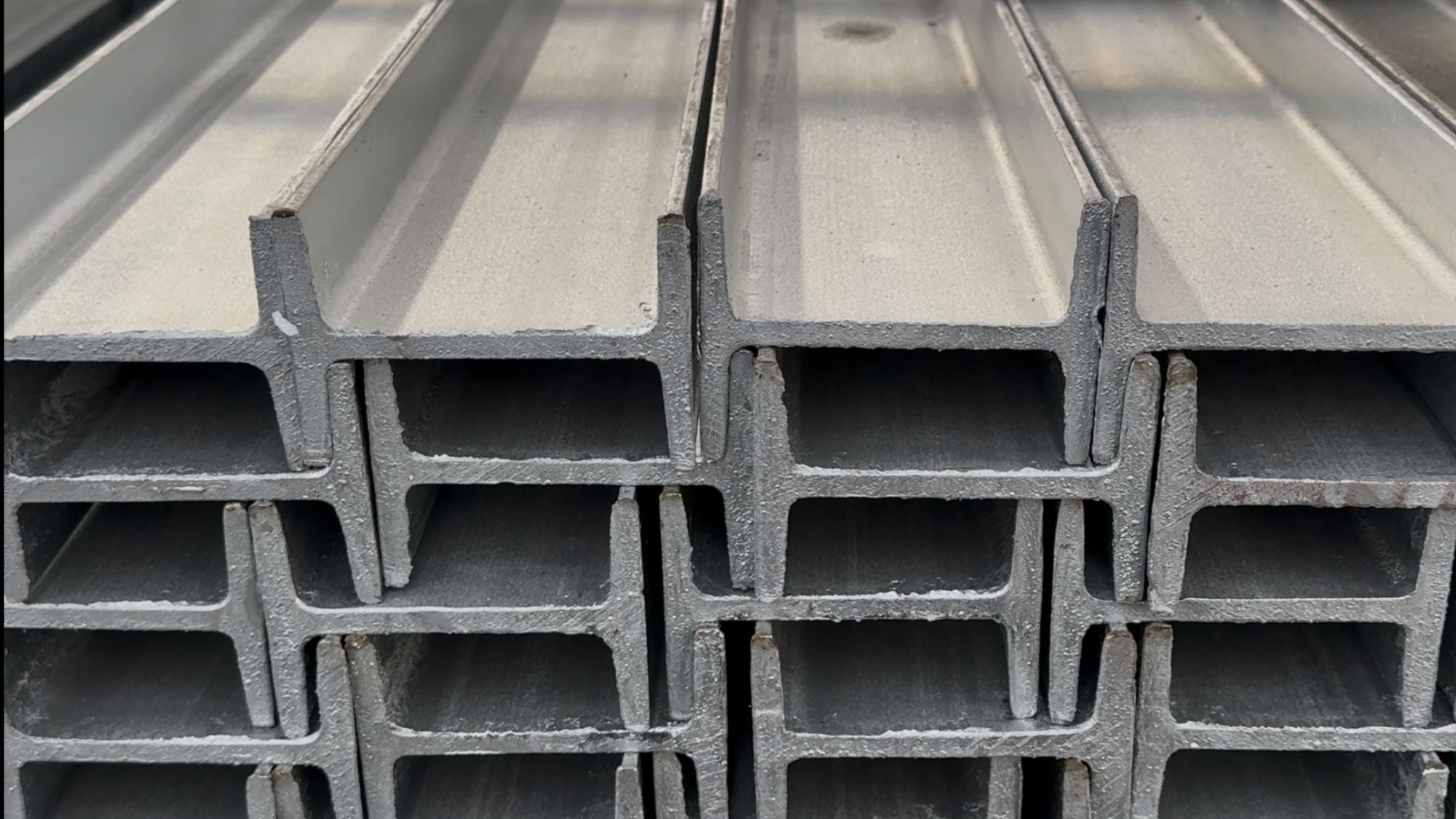
Steel wants to rust. It’s not a flaw; it’s chemistry. When iron meets oxygen and water, the reaction starts almost immediately, flaking away the surface and weakening the structure. Zinc changes that equation. Applied as a thin coating—often through hot-dip galvanizing—it forms a physical shield first, but its real trick is electrochemical. Zinc is more active than steel, so when the two are connected and moisture appears, zinc gives up electrons instead of the iron. It sacrifices itself slowly, buying the steel years or even decades.
That sacrificial layer doesn’t just sit there. As zinc corrodes, it creates a dense, adherent patina of zinc oxide and zinc carbonate. This crust is far less porous than iron rust, and it clings to the surface instead of flaking off. It slows down the very moisture and oxygen that started the reaction, so the zinc’s consumption rate drops sharply after the first exposure. Even if the coating gets scratched, the surrounding zinc keeps protecting the exposed steel—something paint alone can’t do.
The result is a barrier that works on two fronts: it blocks the environment and it actively defends any breach. That’s why galvanized steel shows up on highway guardrails, boat trailers, roof flashing, and utility poles. Rust never really gets a chance to take root because the zinc is always there first, absorbing the damage before the steel ever feels it.
Temperature, Timing, and Thickness on the Galvanizing Line
In practice, bath temperature is less of a setpoint and more of a moving target. A few degrees above 450°C and the iron-zinc reaction accelerates sharply, producing brittle alloy layers and driving dross formation in the pot. Drop too low and viscosity climbs, leaving uneven coating on the strip edges. The best lines hold temperature within a tight band—often less than ±1°C—using induction heaters and careful thermocouple placement, because even a brief drift can show up later as surface roughness or adhesion failures.
Immersion time is usually treated as a simple speed calculation, but thickness turns it into a balancing act. Thin strip heats through in seconds, so a short dip limits over-alloying and keeps the coating ductile. Heavy plate behaves like a heat sink, pulling local bath temperature down and demanding longer contact just to reach metallurgical equilibrium. Operators often adjust line speed in real time rather than relying on a fixed table, since the effective time in the zinc is also shaped by roll geometry and bath depth.
Strip thickness also changes what happens after the pot, especially at the air knives. Thicker material carries more heat and cools slower, so the zinc remains fluid longer and can sag or build up at the edges if the wiping pressure isn't adjusted. Many lines compensate by increasing knife pressure or moving the nozzles slightly for heavy gauges, but this raises the risk of pinholes on thin strip. Getting coating weight right across the width usually comes down to small, continuous corrections rather than a single perfect setting.
Straight, Square, and Ready for the Job Site
On a real job site, crooked stock costs time. You can't fudge a bowed stud into a straight wall or coax a twisted joist into a level floor. That's why every piece in this run gets checked against a true edge before it leaves the yard. No surprises when the saw bites.
The ends are cut clean and square so layout starts without trimming. Consistent dimensions mean fewer shims, less planing, and a rhythm that holds from first plate to final nail. It's lumber that shows up ready to work, not ready to fight you.
Custom Orders Without the Custom Price Tag
You already know the drill: ask for something made to your specs and the quote comes back with a number that makes you wince. We got tired of that too. So we built our production line around flexible templates—real custom choices, not infinite options that jack up the cost. Pick the dimensions, materials, finishes, and details that matter to you. The price stays in the same range as our standard pieces because the custom work happens inside a system designed for it.
That doesn't mean you're stuck with a few token choices. You can change proportions, swap hardware, mix finishes, and add personal touches without triggering a “custom build” surcharge. Most orders ship on the same timeline as our off-the-shelf items, which surprises people. Custom without the custom price tag isn't a marketing line—it's how the workshop is set up.
If you've got something specific in mind, send us the details. We'll tell you straight if it fits the standard custom range, and what it'll cost before you commit. No vague estimates, no last-minute upcharges.
Proven in Ports, Plants, and Parking Structures
Salt air chews through ordinary coatings within months. Yet the gantry cranes at terminals from Long Beach to Singapore still wear the same protective systems installed over a decade ago. Maintenance logs show no rust bleed, no delamination, no costly shutdowns for recoating. That kind of track record doesn’t come from lab simulations—it comes from coatings that have already absorbed the punishment of daily cargo operations, diesel exhaust, and relentless UV exposure.
Inside chemical plants and refineries, the story repeats. Pipe racks, vessel skirts, and structural steel face acidic vapors, thermal cycling, and occasional spills that would strip lesser finishes in weeks. Facility managers keep choosing these same systems because the inspection reports speak clearly: minimal underfilm corrosion, no blistering, and adhesion values that still exceed spec after years of service. When a coating survives a decade in a sour gas unit, it earns a place in the next project spec without debate.
Parking structures present a quieter but equally brutal test. Deicing salts, standing water, and constant foot and vehicle traffic create the perfect environment for corrosion at joints and entry points. Yet the parking decks where these proven coatings were applied show none of the typical spalling or rebar exposure seen in neighboring facilities. The difference is visible from the first walkthrough—no chalky residue on fingertips, no rust stains weeping from cracks, just clean concrete and steel that still looks newly sealed years after opening.
FAQ
The beams begin as high-grade structural steel, then go through a full immersion galvanizing process that adds a tough zinc-iron alloy layer. This bond doesn't just sit on the surface — it becomes part of the steel itself, so the finished beam handles heavy loads and repeated stress without the coating cracking or peeling.
Hot-dip galvanizing completely submerges the I-beam in molten zinc, covering every edge, corner, and interior surface, including areas that are hard to reach with sprays. The resulting coating is typically 3 to 5 times thicker than paint and forms a self-healing zinc patina that continues protecting the steel even if scratched.
We regularly supply structural fabricators, bridge builders, marine construction crews, agricultural equipment manufacturers, and utility companies. Any project that exposes steel to moisture, salt, chemicals, or soil benefits from the extra layer of protection.
Yes, we cut and drill I-beams to exact project specs, from standard wide-flange sections to lighter junior beams. Custom hole patterns, end plates, and camber adjustments are all handled in-house so the beams arrive ready for assembly.
Each batch is checked for zinc coating thickness using magnetic gauges, visually inspected for uniformity, and sampled for adhesion with hammer tests. We also run salt spray tests on request to simulate coastal or industrial exposure.
In normal outdoor conditions, the zinc coating routinely lasts 50 to 70 years without maintenance. Even in aggressive marine or industrial atmospheres, you can expect 20 to 30 years of protection before touch-up is needed.
It is. Zinc is a natural, recyclable element, and galvanized steel can be re-galvanized or recycled at the end of its service life. The long maintenance-free lifespan also means fewer repainting cycles and less solvent waste over time.
For standard sizes already in stock, orders usually ship within 5 to 7 working days. Custom lengths or special hole patterns typically add 2 to 3 weeks, depending on the galvanizing schedule and current production volume.
Conclusion
Hot-dip galvanized I-beams from this factory hold their shape and load rating long after ordinary steel starts to buckle. The reason sits in the galvanizing line itself: temperature, immersion time, and coating thickness are held to narrow tolerances, so the zinc fuses into the steel as a series of iron-zinc alloy layers rather than a superficial skin. That bond gives the beam a tough outer barrier that resists salt spray, abrasion, and moisture creep, and even if the surface gets scratched, the surrounding zinc continues to protect the exposed steel. Thickness checks across the web and flanges prevent the brittle over-coating that can crack under load or during handling. That means fewer replacements and less downtime for structural frames exposed to weather.
The same discipline shows up after galvanizing. Beams come off the line straight and square, without the warping that uneven heating can cause, so they fit the job site without extra grinding or shimming. Custom lengths, copes, bolt patterns, and end plates are handled at standard mill pricing—no special run charges or long lead times. That practicality has been proven in ports, chemical plants, and parking structures, where salt air, humidity, and daily traffic punish unprotected steel. In those environments, these I-beams keep performing year after year, which is the real test behind the claim of unmatched strength and corrosion resistance.
Contact Us
Contact Person: Max Zhou
Email: [email protected]
Tel/WhatsApp: +86 15712216177
Website: https://www.shunchensteelmaterial.com/